Week 5 — Bayesian Networks & Causal Bayes Nets第5週 — ベイズネットと因果ベイズネット

Friday, May 29, 20262026年5月29日(金)

Prof. Joseph Austerweilオウステウェイル ジョセフ教授

Agenda本日の予定

  • Your assignment IS a Bayes net皆さんの課題はベイズネットです 0:00
  • Two complications + notation2つの拡張 + 記号の確認 0:10
  • Chibany Monty Hall + formal definitionチバニーのモンティ・ホール + 正式な定義 0:20
  • d-separation + Bayes-Balld分離 + ベイズボール 0:35
  • Explaining away説明はがし 1:00
  • Break休憩 1:12
  • Observation → intervention観測 → 介入 1:22
  • The do-operatordo演算子 1:32
  • Blicket detectorブリケット検出器 1:47
  • Information theory + close情報理論 + まとめ 1:55

Terminology: four overlapping names用語:重なり合う4つの名前

Before we start — these terms get used loosely, sometimes interchangeably. Here’s the relationship for today:

  • Graphical modelumbrella term. Any probabilistic model drawn as a graph. Includes directed (Bayes nets) and undirected (Markov random fields) variants.
  • Bayesian network (= directed graphical model = belief network) — a DAG where each node is a random variable and arrows encode conditional dependence. Today’s main object.
  • Hierarchical Bayesian model — Week 4’s “priors over priors.” Once drawn as a graph, it’s a Bayes net with at least one extra level of parameter nodes feeding into other parameter nodes. So: every hierarchical Bayesian model is a Bayes net. The reverse isn’t true — a Bayes net without that extra layer (e.g. Monty Hall, which we’ll work through later today) is “flat,” not hierarchical.
  • Causal Bayesian network — same DAG, but arrows now mean direct causation. Adds the do-operator (Pearl). Every causal BN is a Bayes net; not every Bayes net is causal.

GMM = hierarchical Bayes ⊂ Bayes net ⊂ graphical model. Causal BN = Bayes net + causal reading.

始める前に — これらの用語は緩く、時には互換的に使われます。今日のための関係:

  • グラフィカルモデル総称。グラフとして描かれる確率モデル全般。 有向(ベイズネット)と無向(マルコフ確率場)の両方を含む。
  • ベイズネット (= 有向グラフィカルモデル = 信念ネットワーク)DAG で、各ノードが確率変数、矢印が条件付き依存性を表す。今日の主役。
  • 階層ベイズモデル — 第4週の「事前分布の上の事前分布」。グラフに描けば、 パラメータノードが別のパラメータノードに流れ込む追加の層 を持つベイズネット。 つまり:階層ベイズモデルはすべてベイズネット。 逆は真ではない — その追加の 層がないベイズネット(例:モンティ・ホール、今日後で扱います)は「フラット」で あり、階層的ではない。
  • 因果ベイズネット — 同じDAGだが、矢印は 直接的な因果関係 を意味する。 do演算子(Pearl)が加わる。因果BN はすべてベイズネット;ベイズネットがすべて 因果的なわけではない。

GMM = 階層ベイズ ⊂ ベイズネット ⊂ グラフィカルモデル。因果BN = ベイズネット + 因果的解釈。

Your assignment IS a Bayes net皆さんの課題はベイズネットです

Welcomeようこそ

Week 5 of Human and Machine Learning.

Last week we wrestled with hierarchical Bayes — priors over priors. Right now most of you are mid-Clusters, working out Gaussian mixtures.

Today’s claim: those are the same thing, drawn as a graph.

人間と機械の学習、第5週。

先週は 階層ベイズ — 事前分布の上の事前分布 — に取り組みました。 今は皆さんの多くがクラスタ課題の途中で、ガウス混合モデル を解いていますね。

今日の主張:その2つは同じものを、グラフで描いただけだ、ということです。

Chibany’s histogram, drawn differentlyチバニーのヒストグラム、別の描き方で

Remember Chibany’s mystery bentos? Two peaks at 350g and 500g.

In Clusters you’re writing a two-Gaussian mixture as a generative process and computing what each datapoint tells you about which cluster it came from.

Today’s claim: that generative process is a Bayes net. Same model — just drawn. You’ve been doing Bayesian-network inference all week without naming it.

We’ll leave the density and the “which cluster?” formula to your assignment — no spoilers today.

チバニーのミステリー弁当を覚えていますか?350g と 500g の2つのピーク。

クラスタ課題では、2成分ガウス混合を 生成過程 として書き、各データ点が どのクラスタから来たかを計算していますね。

今日の主張:その生成過程は ベイズネットそのもの。同じモデル、ただ図に描いただけ。 皆さんは今週ずっと、名前を付けずにベイズネットの推論をしていたんです。

密度の式と「どのクラスタか?」の式は課題で導出してもらうので、今日はネタバレなし。

The generative process you wrote皆さんが書いた生成過程

In Clusters Problem 2, you wrote the two-Gaussian mixture as:

\[c_n \mid \theta \;\sim\; \mathrm{Bernoulli}(\theta)\] \[x_n \mid \mu_{c(n)},\, \sigma^2_{c(n)} \;\overset{iid}{\sim}\; \mathrm{N}(\mu_{c(n)},\, \sigma^2_{c(n)})\]

Two lines. Each line is one sampling step. Today we’ll show that this generative process is already a Bayes net — we just haven’t drawn it yet.

クラスタの問題2 では、2成分ガウス混合を次のように書きました:

\[c_n \mid \theta \;\sim\; \mathrm{Bernoulli}(\theta)\] \[x_n \mid \mu_{c(n)},\, \sigma^2_{c(n)} \;\overset{iid}{\sim}\; \mathrm{N}(\mu_{c(n)},\, \sigma^2_{c(n)})\]

2行。各行が 1つのサンプリングステップ。今日は、この生成過程が すでにベイズネットである ことを示します — 単にまだ図に描いていないだけ。

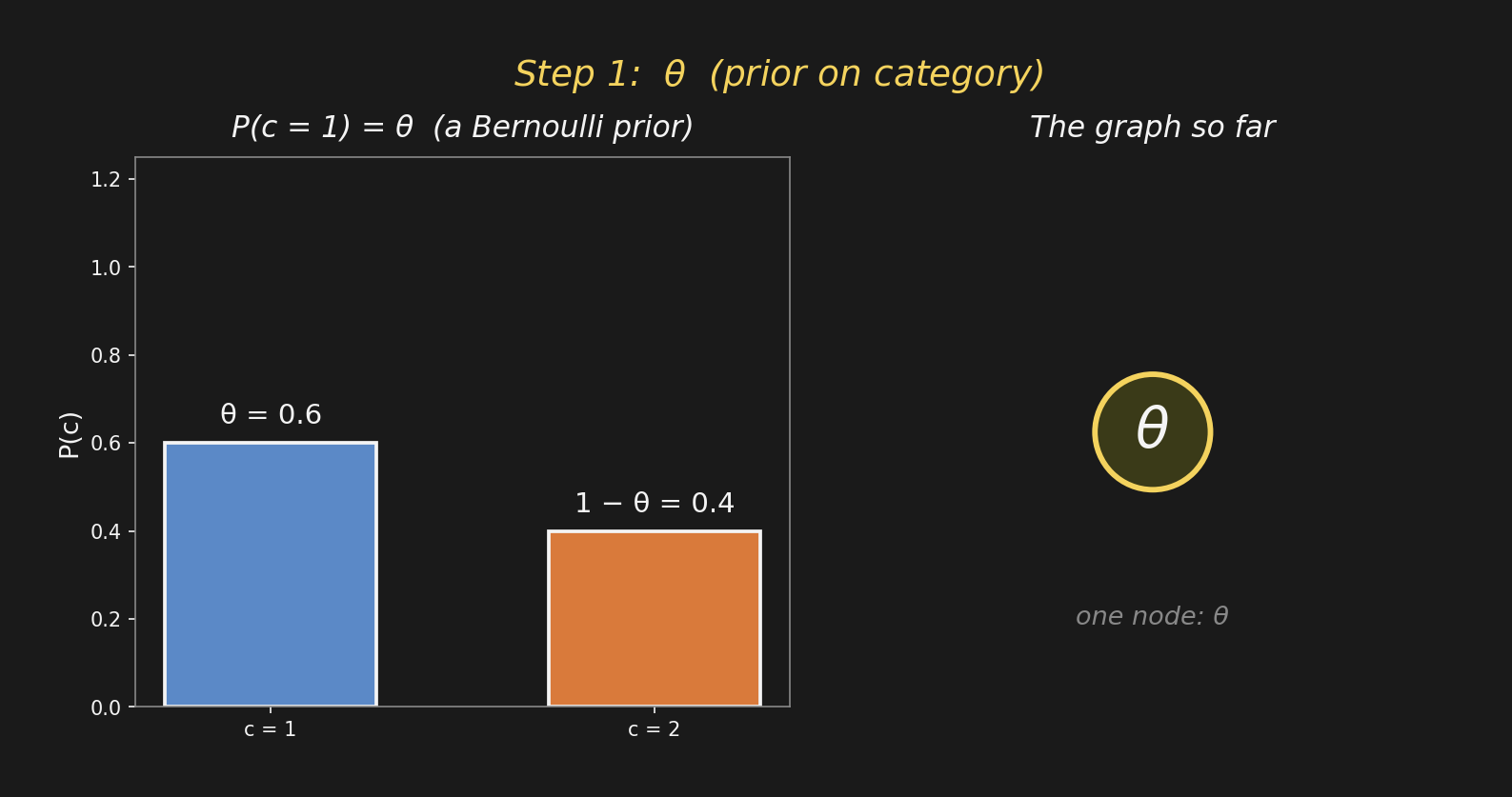
Step 1: introduce θステップ1:θを導入

The Bernoulli prior on the left has one parameter, \(\theta\). On the right, \(\theta\) becomes one node of the graph. A node = a random variable (or parameter) in the model.

左のベルヌーイ事前分布にはパラメータ \(\theta\) が1つ。右では、\(\theta\) がグラフの ノード の1つになる。ノード = モデル中の確率変数(またはパラメータ)。

Step 2: sample \(c_n \sim \mathrm{Bernoulli}(\theta)\)ステップ2:\(c_n \sim \mathrm{Bernoulli}(\theta)\) をサンプル
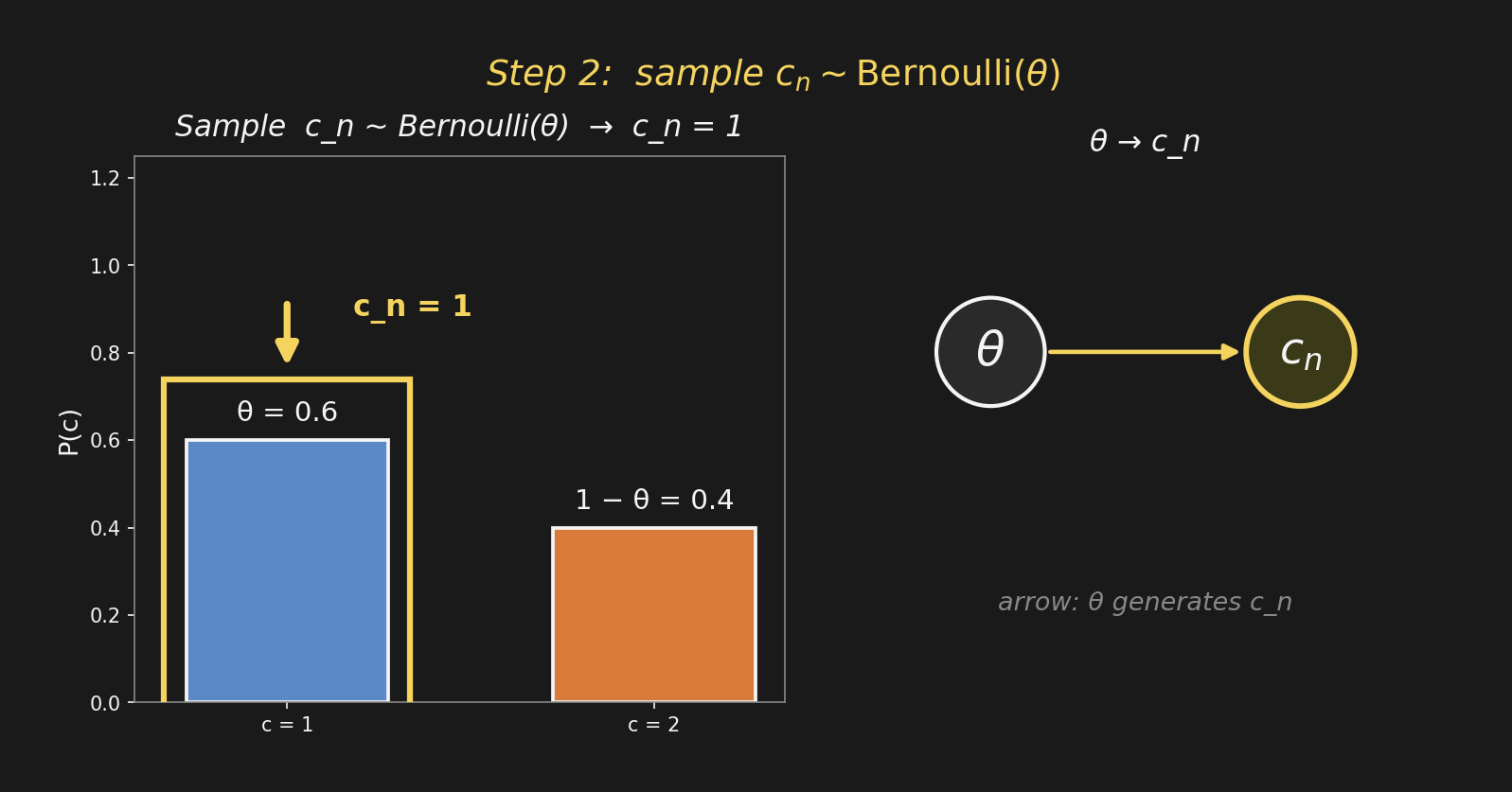
Sampling \(c_n\) flips a θ-weighted coin. Pick category 1 (highlighted bar). On the graph: \(c_n\) becomes a new node, and the line \(c_n \mid \theta \sim \mathrm{Bernoulli}(\theta)\) becomes an arrow from θ to \(c_n\).

Generative-process line ↔︎ arrow in the graph.

\(c_n\) のサンプリングは、θ で重み付けされたコインを振る。カテゴリ1 を選ぶ(黄色いバー)。 グラフの上では: \(c_n\) が新しいノードになり、\(c_n \mid \theta \sim \mathrm{Bernoulli}(\theta)\) という行は θ から \(c_n\) への 矢印 になる。

生成過程の1行 ↔︎ グラフの矢印1本。

Step 3: introduce the componentsステップ3:成分を導入
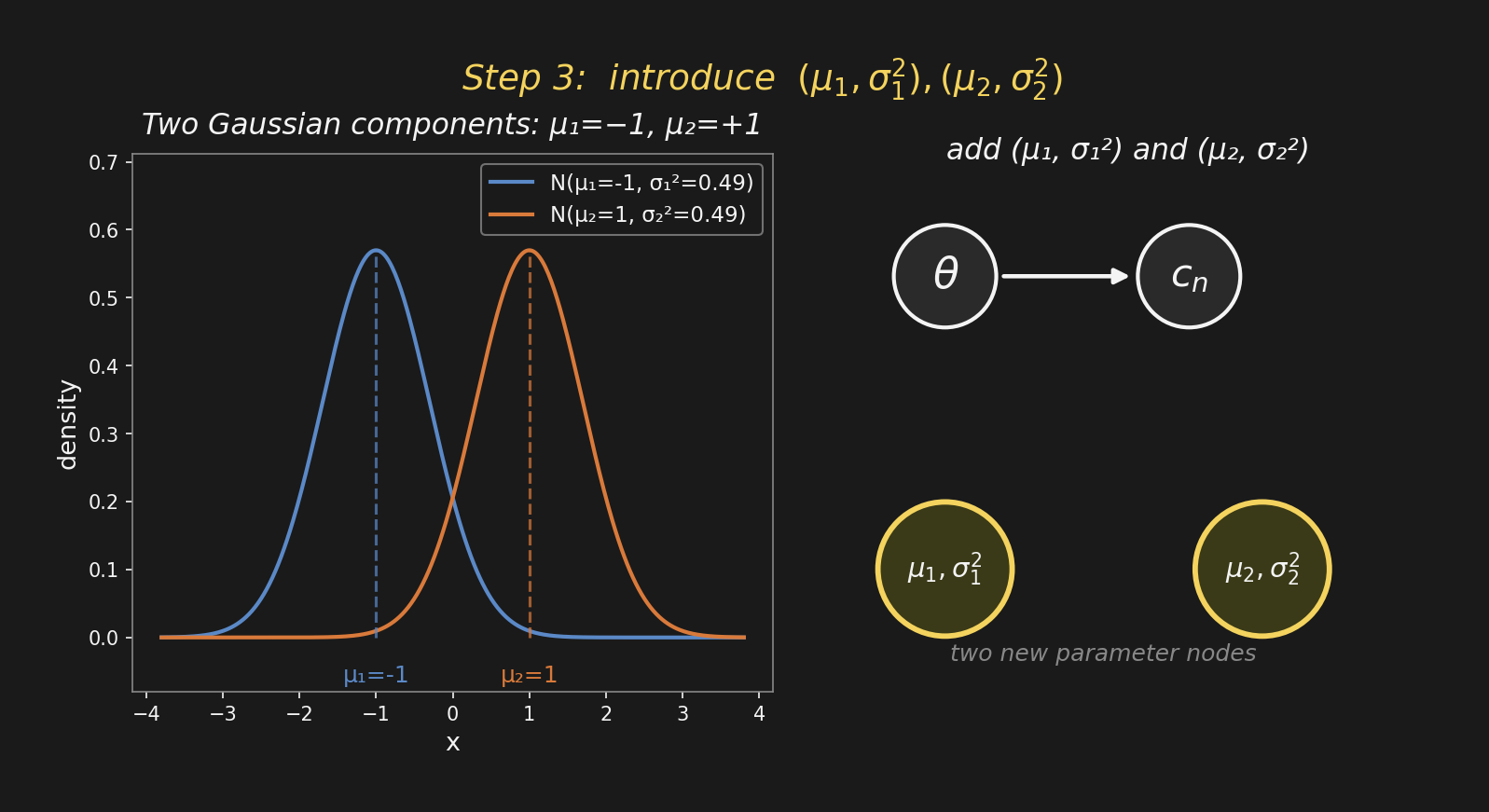
The two Gaussians have parameters \((\mu_1, \sigma_1^2)\) and \((\mu_2, \sigma_2^2)\). On the graph: two new nodes for the parameters — one pair per component.

We’re not yet drawing arrows from these into \(x_n\). That happens in the next step.

2つのガウス分布のパラメータは \((\mu_1, \sigma_1^2)\)\((\mu_2, \sigma_2^2)\)グラフの上では: パラメータごとに新しいノード — 成分ごとに1ペア。

まだ \(x_n\) への矢印は描かない。それは次のステップ。

Step 4: sample \(x_n\), the observationステップ4:観測 \(x_n\) をサンプル
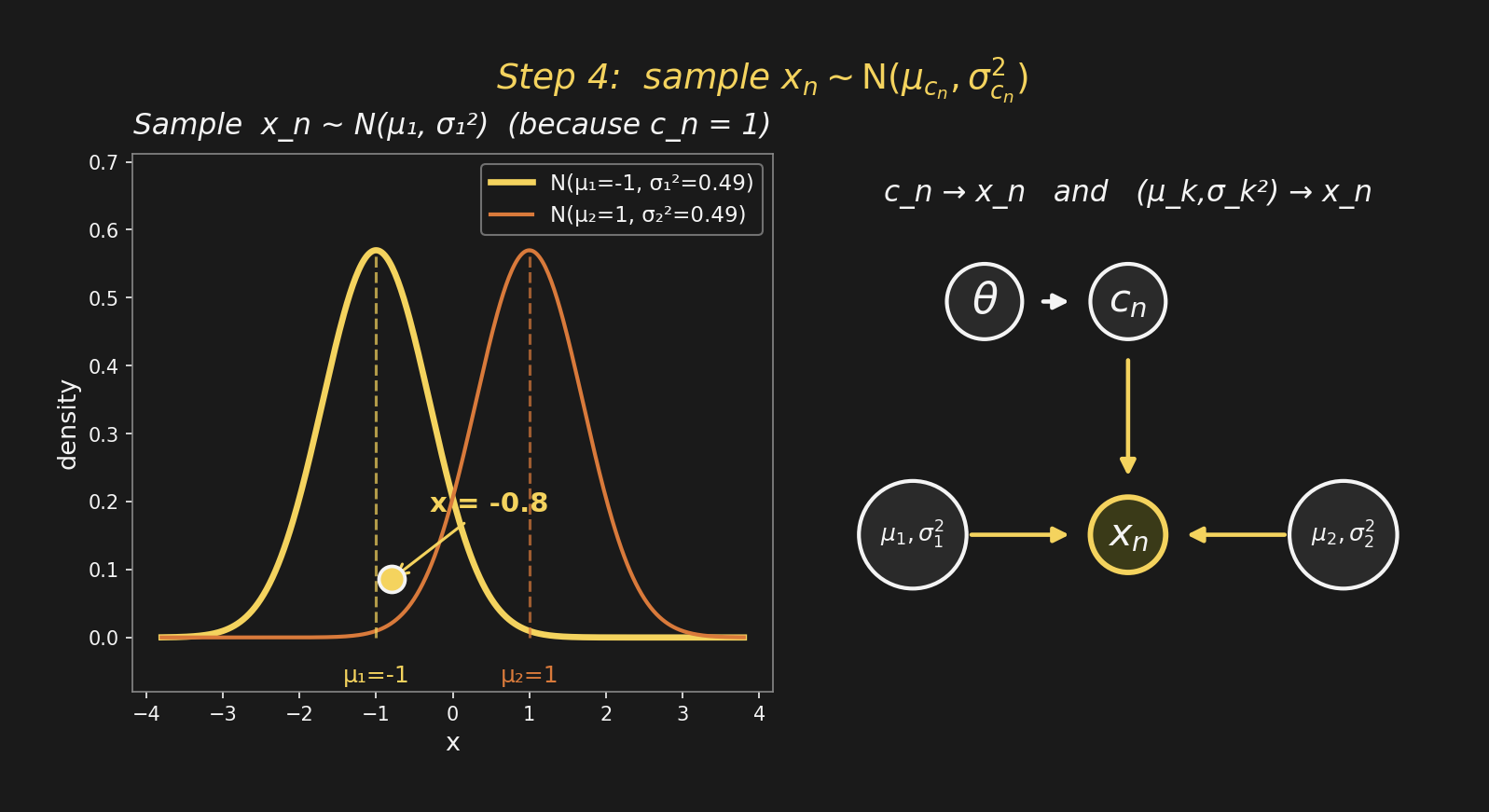
With \(c_n = 1\), we sample \(x_n \sim \mathrm{N}(\mu_1, \sigma_1^2)\) — a point under the highlighted Gaussian. On the graph: \(x_n\) is a new node (shaded — it’s observed), with arrows from \(c_n\) and from each \((\mu_k, \sigma_k^2)\).

The second generative-process line gave us three new arrows at once.

\(c_n = 1\) のとき、\(x_n \sim \mathrm{N}(\mu_1, \sigma_1^2)\) をサンプル — 黄色いガウス分布の下の1点。グラフの上では: \(x_n\) は新しいノード(網掛け = 観測済み)、\(c_n\) と各 \((\mu_k, \sigma_k^2)\) から矢印が入る。

生成過程の2行目で、矢印が3本 一気に加わった。

Step 5: do this N timesステップ5:これを N 回繰り返す
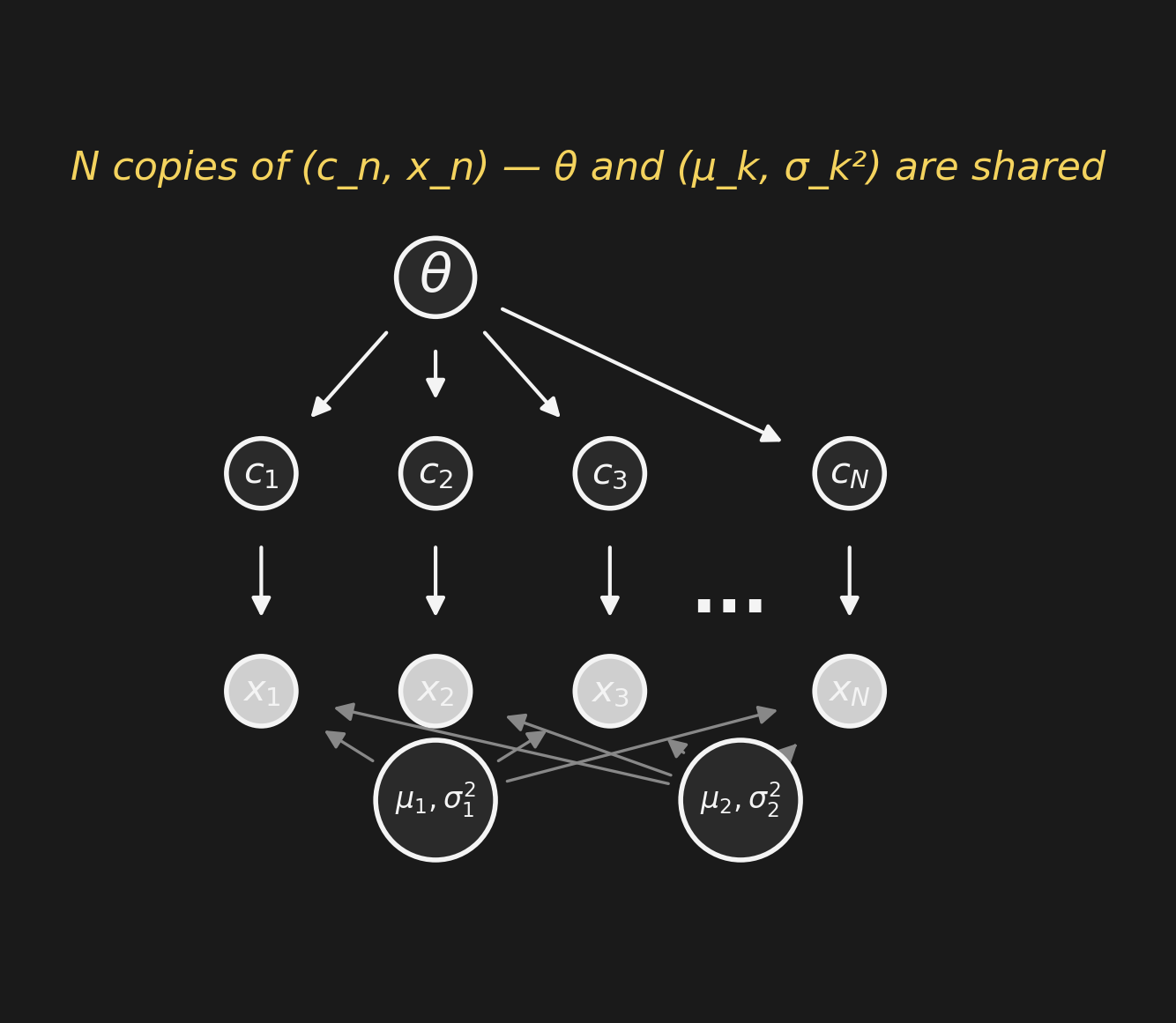
The generative process has \(n = 1, \ldots, N\). Each \(n\) gets its own \((c_n, x_n)\) — but \(\theta\) and the \((\mu_k, \sigma_k^2)\) are shared.

Drawn explicitly, this is an N-fold copy of the same little pattern.

生成過程は \(n = 1, \ldots, N\) にわたる。各 \(n\) に独自の \((c_n, x_n)\) — しかし \(\theta\)\((\mu_k, \sigma_k^2)\)共有される

明示的に描くと、同じ小さなパターンの N 個のコピー。

Step 6: the plate — a shortcutステップ6:プレート — 略記法
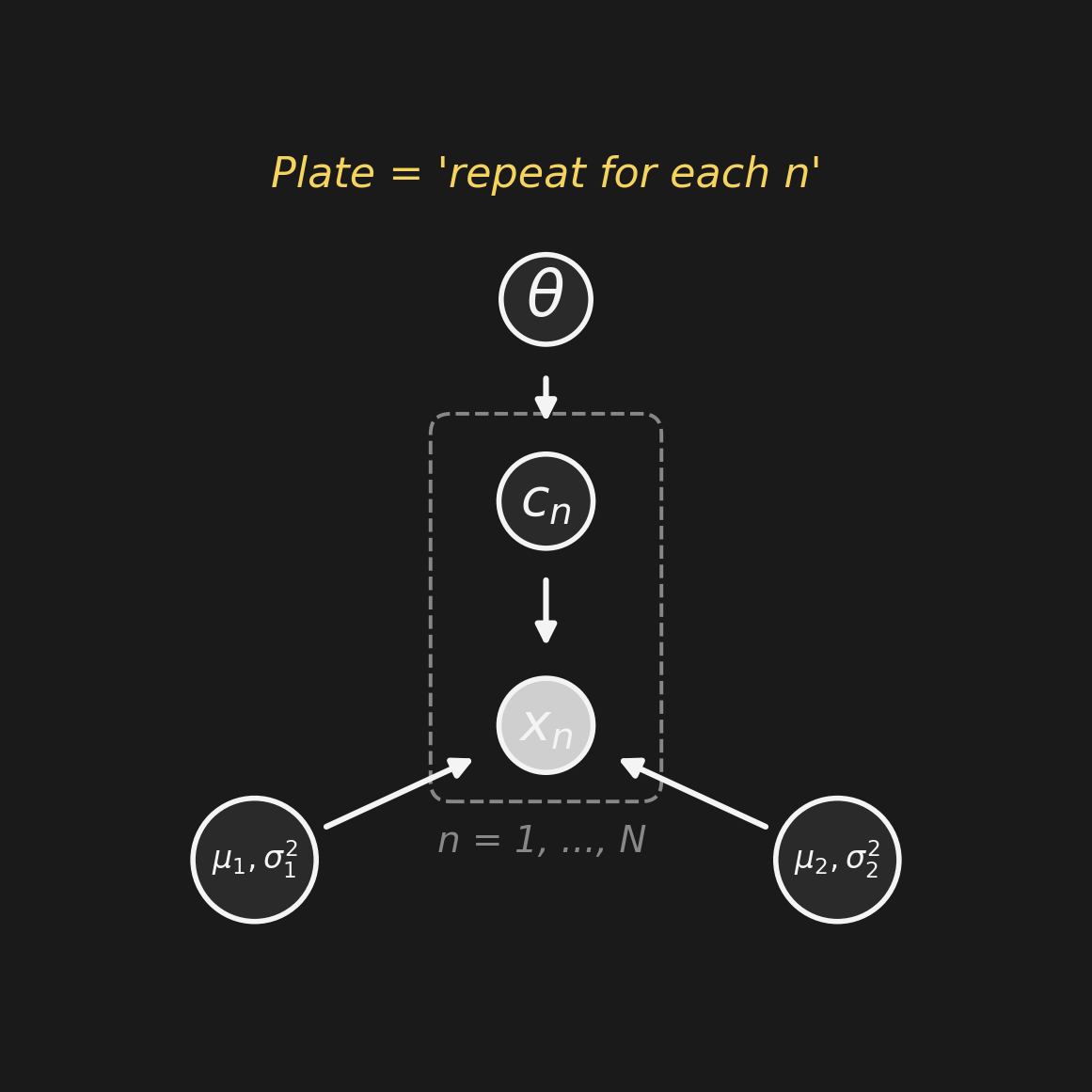
Plate notation: draw the repeating pattern once inside a dashed box, and label the box “\(n = 1, \ldots, N\).” The plate means “copy everything inside, N times.”

Same graph, vastly more compact.

プレート記法: 繰り返しパターンを 1回だけ 破線の箱の中に描き、箱に “\(n = 1, \ldots, N\)” とラベルを付ける。プレートの意味は 「中身を N 回コピー」

同じグラフ、はるかにコンパクト。

Step 7: generalize to K componentsステップ7:K成分に一般化
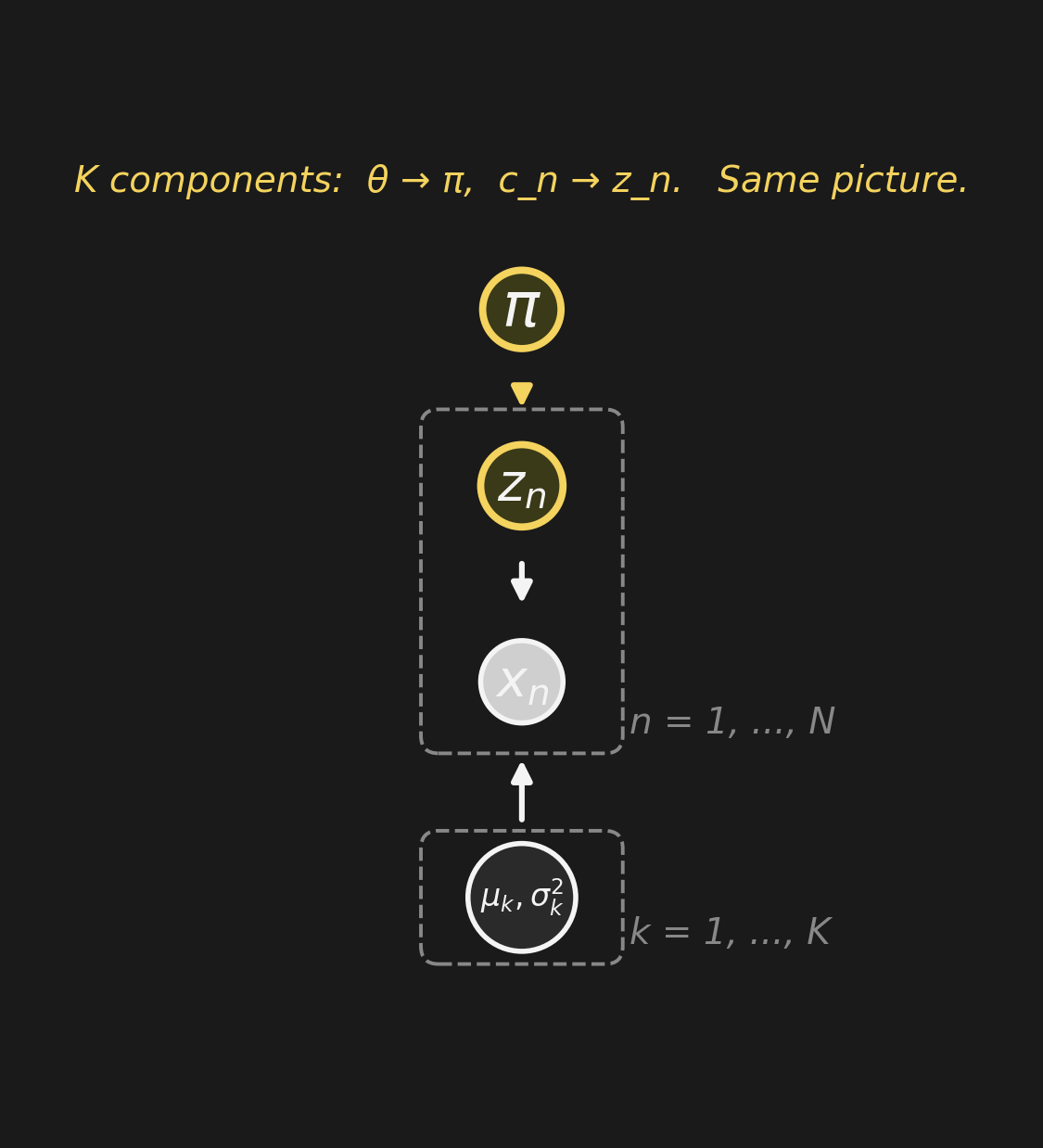
Bernoulli(\(\theta\)) generalizes to Categorical(\(\pi\)) for K components. \(c_n \to z_n\), \(\theta \to \pi\), and \((\mu_k, \sigma_k^2)\) gets a K-plate.

Same picture. Two clusters or two hundred — the graph language stayed put.

Bernoulli(\(\theta\)) は K 成分の場合の Categorical(\(\pi\)) に一般化される。 \(c_n \to z_n\)\(\theta \to \pi\)\((\mu_k, \sigma_k^2)\) には K-プレートを付ける。

同じ絵。 2つのクラスタでも200個でも — グラフ言語はそのまま。

The choice of K — DPMM (T3 Ch 6) avoids fixing it. Week 10 picks this up.

Reading inference off the graphグラフから推論を読み取る

You’ve now seen the graph. Two things to take away — without writing down the formula (that’s your assignment):

  • Down the arrow = generative direction. Sample \(\theta\), then \(c_n\), then \(x_n\).
  • Up the arrow = inference direction. Observe \(x_n\), ask which \(c_n\) generated it.

The “which cluster?” calculation you’re doing in Clusters Problem 2 is inference going UP the arrow from \(x_n\) to \(c_n\). Prior → likelihood → posterior, read off the parent–child structure.

We won’t write the formula here — finish the assignment first; we’ll discuss after Friday.

グラフを見たので、2つの要点を持ち帰ってください — 式は書かずに(それは課題):

  • 矢印を下る = 生成方向。\(\theta\) をサンプル、次に \(c_n\)、次に \(x_n\)
  • 矢印を上る = 推論方向。\(x_n\) を観測して、どの \(c_n\) から来たかを問う。

クラスタ課題の問題2 でやっている「どのクラスタか?」の計算は、まさに \(x_n\) から \(c_n\) へ矢印を上る推論。事前 → 尤度 → 事後を、親子構造から読み取る。

式はここでは書きません — まず課題を提出してから、金曜後に解説します。

Two complications + notation2つの拡張 + 記号の確認

Where do the priors come from?事前分布はどこから来るのか?
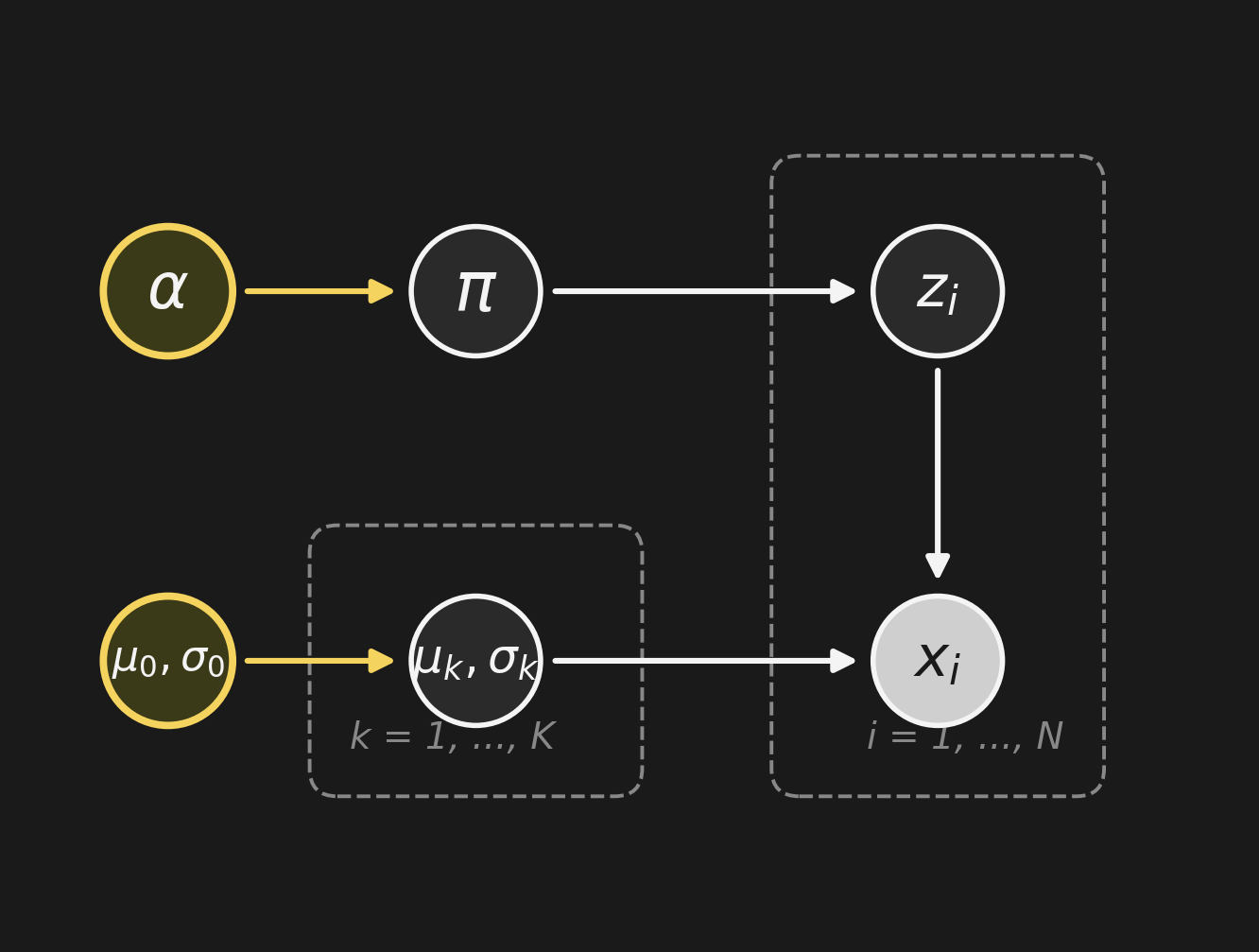
Add a hyperprior: \(\alpha \to \pi\) and \((\mu_0, \sigma_0) \to (\mu_k, \sigma_k)\).

This is exactly Week 4’s hierarchical Bayes, drawn as a graph. The graph language already covered it; we just didn’t have the words yet.

ハイパー事前分布 を追加する:\(\alpha \to \pi\)\((\mu_0, \sigma_0) \to (\mu_k, \sigma_k)\)

これは 先週の階層ベイズそのもの を、グラフで描いたものです。 グラフという言語ですでに表現できていたのに、その言葉を持っていなかっただけ。

What if there are multiple parents?親ノードが複数ある場合は?

Chibany realizes: the bento (\(B\)) weight depends on more than just which cluster.

  • Weather (\(W\)) — hot days mean lighter bentos
  • Day of the week (\(D\)) — the cafeteria menu rotates
  • Restaurant (\(R\)) — different students come from different places

Multiple causes, one observation. How does the picture handle that?

We’ll use \(W\), \(D\), \(R\), \(B\) as shorthand for these variables from here on.

チバニーは気づきます: 弁当 (\(B\)) の重さは、どのクラスタかだけでは決まらない。

  • 天気 (\(W\)) — 暑い日は軽めの弁当
  • 曜日 (\(D\)) — カフェテリアのメニューはローテーション
  • レストラン (\(R\)) — 学生によって出身地が違う

複数の原因、1つの観測値。 グラフはこれをどう扱う?

以降、これらの変数を \(W\), \(D\), \(R\), \(B\) と略記します。

Chibany’s full bento networkチバニーの完全な弁当ネットワーク
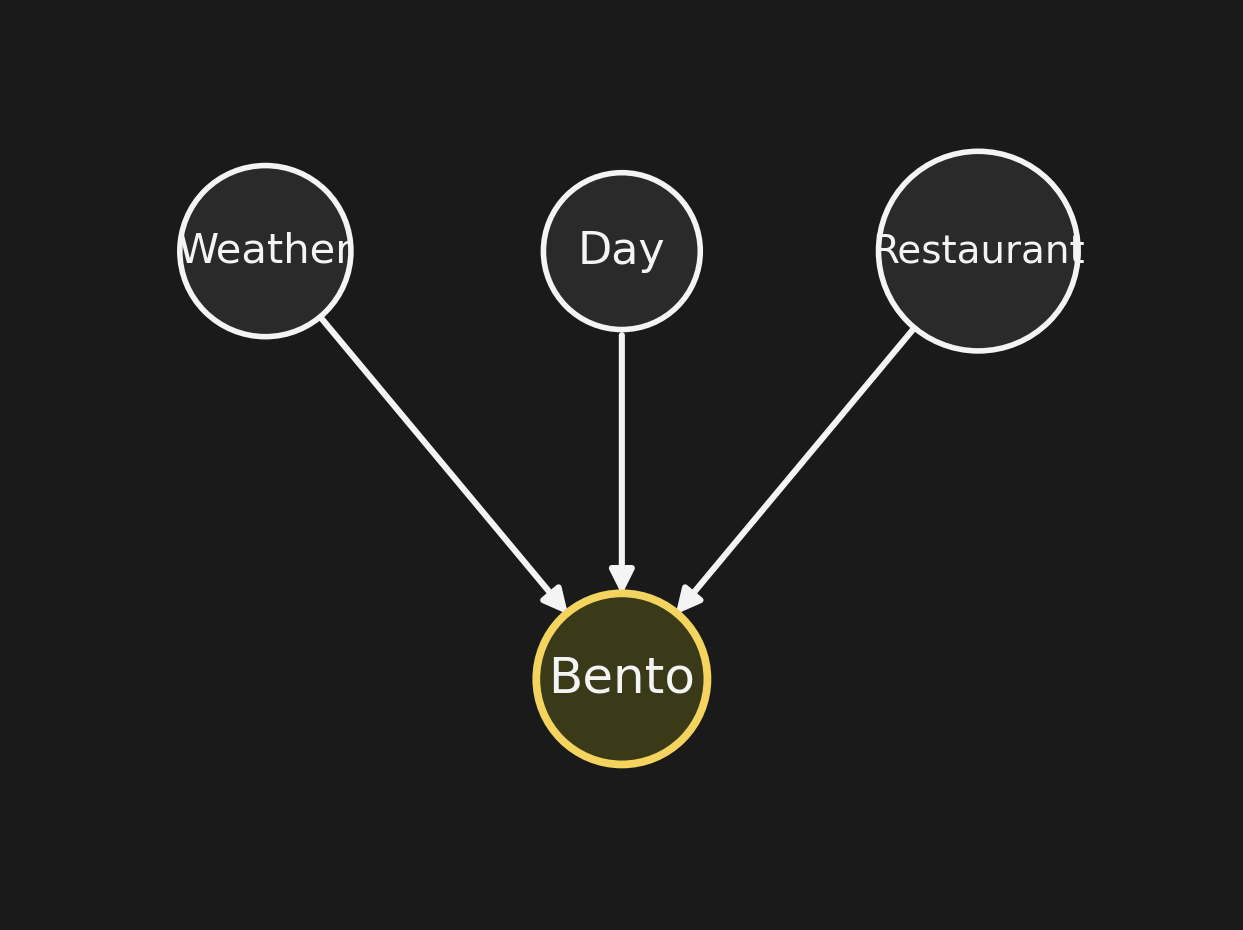
Three parents pointing into Bento. What’s the joint distribution?

3つの親ノードが弁当に向かう。同時分布は何になるか?

The rule for multiple parents親が複数あるときのルール

Each parent contributes a factor. The joint factorizes as: \[P(W, D, R, B) \;=\; P(W) \, P(D) \, P(R) \, P(B \mid W, D, R)\]

  • \(W\), \(D\), \(R\) have no parents → marginals.
  • \(B\) has three parents → conditional on all three.

One factor per node, conditioned on that node’s parents. That’s the rule.

各親ノードが因子を1つ提供する。同時分布は次のように因数分解される: \[P(W, D, R, B) \;=\; P(W) \, P(D) \, P(R) \, P(B \mid W, D, R)\]

  • \(W\)\(D\)\(R\) には親がない → 周辺確率。
  • \(B\) には3つの親 → 3つすべて に条件付けられる。

各ノードにつき1つの因子、その親に条件付けられた形で。 これがルールです。

Notation lock-in記号の確認

Symbols we’ll use:

  • \(G = (V, E)\) — a directed acyclic graph (DAG)
  • \(\text{Pa}(X)\) — the parents of node \(X\) in \(G\)

使う記号:

  • \(G = (V, E)\)有向非巡回グラフ (DAG)
  • \(\text{Pa}(X)\) — グラフ \(G\) における \(X\) ノード

Three examples so far:

  • GMM: \(\text{Pa}(z_i) = \{\pi\}\), \(\text{Pa}(x_i) = \{z_i\}\)
  • GMM + hyperprior: add \(\text{Pa}(\pi) = \{\alpha\}\)
  • Bento: \(\text{Pa}(B) = \{W, D, R\}\)

ここまでの3つの例:

  • GMM: \(\text{Pa}(z_i) = \{\pi\}\)\(\text{Pa}(x_i) = \{z_i\}\)
  • ハイパー事前を追加: \(\text{Pa}(\pi) = \{\alpha\}\)
  • 弁当ネット: \(\text{Pa}(B) = \{W, D, R\}\)

Joint factorizes as: \[P(X_1, \ldots, X_n) = \prod_i P(X_i \mid \text{Pa}(X_i))\]

Same picture, same rule, three problems.

同時分布の因数分解: \[P(X_1, \ldots, X_n) = \prod_i P(X_i \mid \text{Pa}(X_i))\]

同じ絵、同じルール、3つの問題。

Chibany Monty Hall + formal definitionチバニーのモンティ・ホール + 正式な定義

A new puzzle for Chibanyチバニーへの新しい謎

The cafeteria scenario. Three bento boxes on the counter. Exactly one of them contains tonkatsu (the other two don’t). Chibany picks box 1. The cafeteria worker — who knows which box has the tonkatsu — opens box 3 and reveals: not tonkatsu.

Should Chibany switch to box 2?

カフェテリアでの場面。 カウンターに3つのお弁当。そのうちちょうど1つだけが トンカツ(残りの2つは違う)。チバニーは 1番 を選んだ。カフェテリア店員 — どの箱がトンカツかを 知っている — が 3番 を開けて:トンカツじゃない、と見せる。

チバニーは2番に変えるべきか?

As a Bayes netベイズネットとして

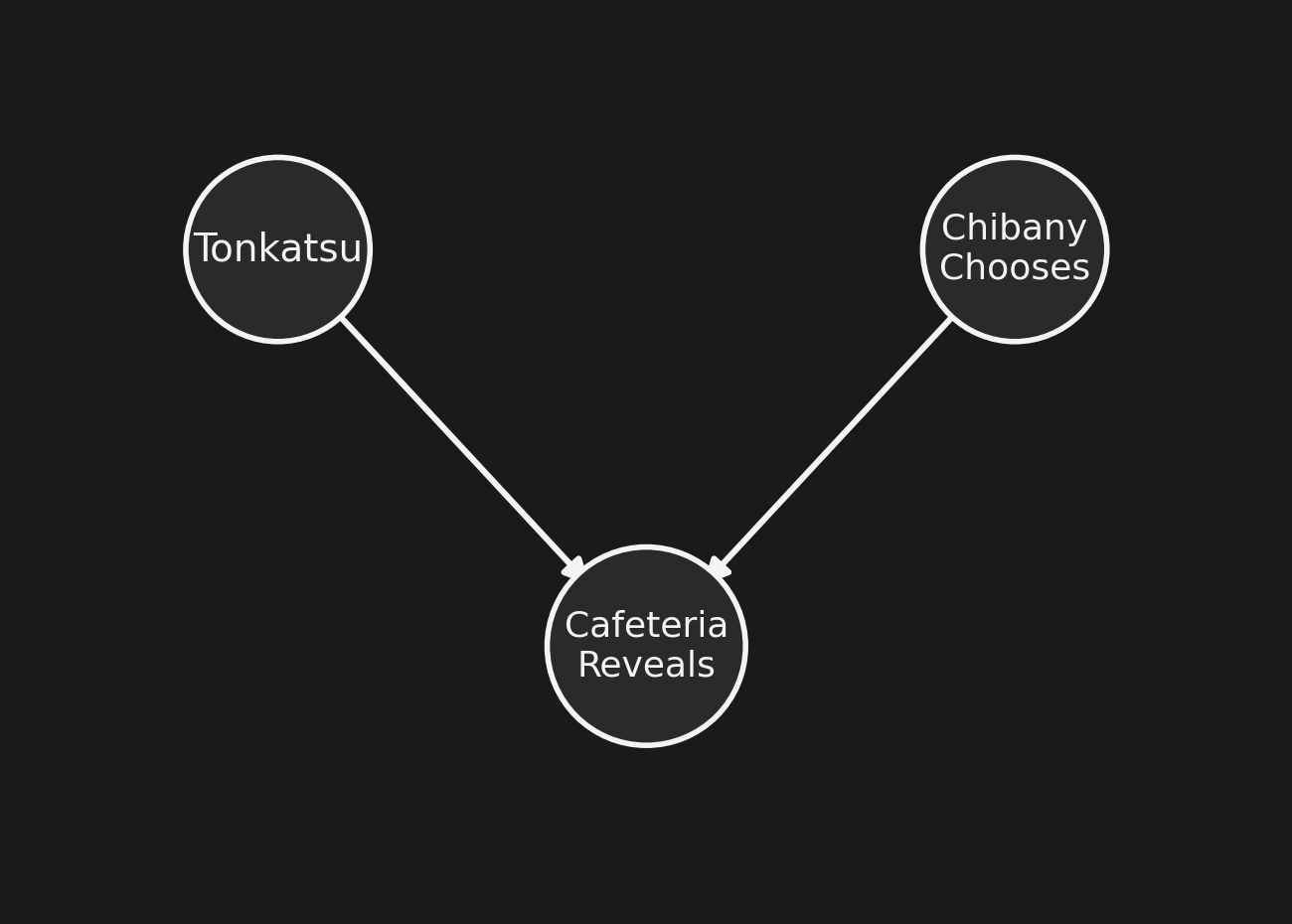
Three nodes:

  • Tonkatsu (\(T\)): which box has it. Uniform: each box, 1/3.
  • Chibany Chooses (\(C\)): which box Chibany chose. Independent of Tonkatsu.
  • Cafeteria Reveals (\(R\)): which box the worker opens — depends on both parents.

A collider: two arrows pointing into the same node.

We’ll use \(T\), \(C\), \(R\) as shorthand for these from here on. (\(C\) for Chibany’s choice — avoids clashing with \(P(\cdot)\) for probability.)

3つのノード:

  • トンカツ (\(T\)):どの箱に入っているか。一様分布:各箱 1/3。
  • チバニーの選択 (\(C\)):チバニーがどの箱を選ぶか。トンカツの位置とは独立。
  • 店員の公開 (\(R\)):店員がどの箱を開けるか — 両方 の親ノードに依存。

コライダー(合流点):2つの矢印が同じノードに向かう構造。

以降、これらの変数を \(T\), \(C\), \(R\) と略記します。(\(C\) は Chibany’s choice — 確率の \(P(\cdot)\) と紛れないように。)

Joint factorization同時分布の因数分解

The graph gives us: \[P(T, C, R) \;=\; P(T) \, P(C) \, P(R \mid T, C)\]

  • \(P(T) = 1/3\) for each box
  • \(P(C) = 1/3\) for each box (we’ll assume Chibany chooses uniformly)
  • \(P(R \mid T, C)\) — the cafeteria worker’s policy: open a box that’s neither the tonkatsu nor Chibany’s choice.

Before any observation, each box has probability 1/3 of being tonkatsu.

グラフから次が得られる: \[P(T, C, R) \;=\; P(T) \, P(C) \, P(R \mid T, C)\]

  • \(P(T) = 1/3\) 各箱について
  • \(P(C) = 1/3\) 各箱について(チバニーは一様に選ぶと仮定)
  • \(P(R \mid T, C)\) — 店員のポリシー:トンカツの箱でもチバニーの選択でもない箱を開ける。

何も観測する前は、各箱がトンカツである確率は 1/3。

Now condition: \(P(T \mid R = 3, C = 1)\)ここで条件付け: \(P(T \mid R = 3, C = 1)\)

We observe \(C = 1\) (Chibany chose box 1) and \(R = 3\) (worker opened box 3). What’s the posterior over \(T\)?

Two cases that matter:

  • \(T = 1\) (Chibany’s choice is right). Worker opens box 2 OR box 3 — picks uniformly. So \(P(R = 3 \mid T = 1, C = 1) = 1/2\).
  • \(T = 2\) (the other unopened box). Worker MUST open box 3 (only choice that’s neither 1 nor 2). So \(P(R = 3 \mid T = 2, C = 1) = 1\).
  • \(T = 3\) (impossible — worker just revealed it). \(P(R = 3 \mid T = 3, C = 1) = 0\).

\(C = 1\)(チバニーは1番を選んだ)と \(R = 3\)(店員は3番を開けた)を観測。 \(T\) の事後分布は?

重要な3つのケース:

  • \(T = 1\)(チバニーの選択が正解)。店員は2番か3番を一様に選ぶ。\(P(R = 3 \mid T = 1, C = 1) = 1/2\)
  • \(T = 2\)(もう一つの未開封)。店員は3番を開けるしか ない(1でも2でもない箱)。\(P(R = 3 \mid T = 2, C = 1) = 1\)
  • \(T = 3\)(不可能 — 店員が開けたので)。\(P(R = 3 \mid T = 3, C = 1) = 0\)

Bayes’ rule gives the answerベイズの定理で答えが出る

\[P(T = k \mid R = 3, C = 1) \;\propto\; P(R = 3 \mid T = k, C = 1) \, P(T = k)\]

\(T\) Prior Likelihood Unnormalized
1 1/3 1/2 1/6
2 1/3 1 1/3
3 1/3 0 0

Normalize: \(P(T = 1 \mid \cdot) = 1/3\), \(P(T = 2 \mid \cdot) = 2/3\).

Chibany should switch.

\[P(T = k \mid R = 3, C = 1) \;\propto\; P(R = 3 \mid T = k, C = 1) \, P(T = k)\]

\(T\) 事前 尤度 正規化前
1 1/3 1/2 1/6
2 1/3 1 1/3
3 1/3 0 0

正規化:\(P(T = 1 \mid \cdot) = 1/3\)\(P(T = 2 \mid \cdot) = 2/3\)

チバニーは変えるべきだ。

Now name it: the Markov factorization正式名称: マルコフ因数分解

Definition. A Bayesian network for variables \(X_1, \ldots, X_n\) is a directed acyclic graph \(G\) — one node per variable — together with a conditional distribution \(P(X_i \mid \text{Pa}_G(X_i))\) at each node.

Theorem (Markov factorization). The joint distribution factorizes as \[P(X_1, \ldots, X_n) \;=\; \prod_{i=1}^{n} P(X_i \mid \text{Pa}_G(X_i)).\]

You’ve used this rule three times already — mixture, hyperprior, bento — and just used it for the Monty Hall posterior. Now it has a name.

定義. 変数 \(X_1, \ldots, X_n\)ベイズネット とは、変数ごとに1ノードの 有向非巡回グラフ(DAG) \(G\) と、各ノードの 条件付き分布 \(P(X_i \mid \text{Pa}_G(X_i))\) の組。

定理(マルコフ因数分解). 同時分布は次のように因数分解される: \[P(X_1, \ldots, X_n) \;=\; \prod_{i=1}^{n} P(X_i \mid \text{Pa}_G(X_i)).\]

このルールはすでに3回使いました — 混合、ハイパー事前、弁当 — そしてモンティ・ホールで事後分布も計算した。やっと名前が付いた。

How compact is this?どれくらいコンパクトか?

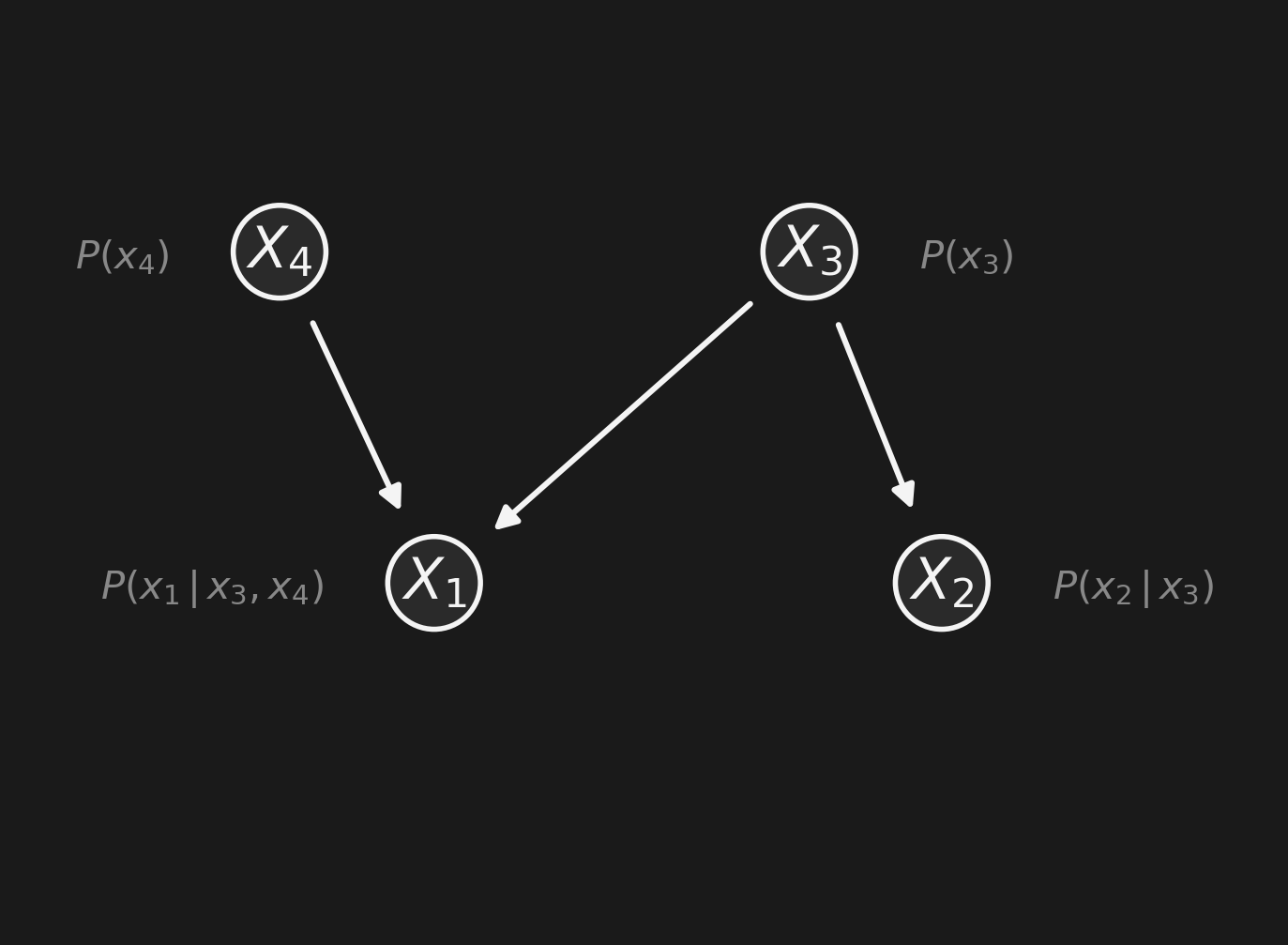
For 4 binary variables, the full joint needs \(2^4 - 1 = 15\) numbers. This Bayes net needs how many?

2値変数4つの場合、完全な同時分布 には \(2^4 - 1 = 15\) 個の数が必要。 このベイズネットは何個で済むか?

How compact is this? — answerどれくらいコンパクトか? — 答え
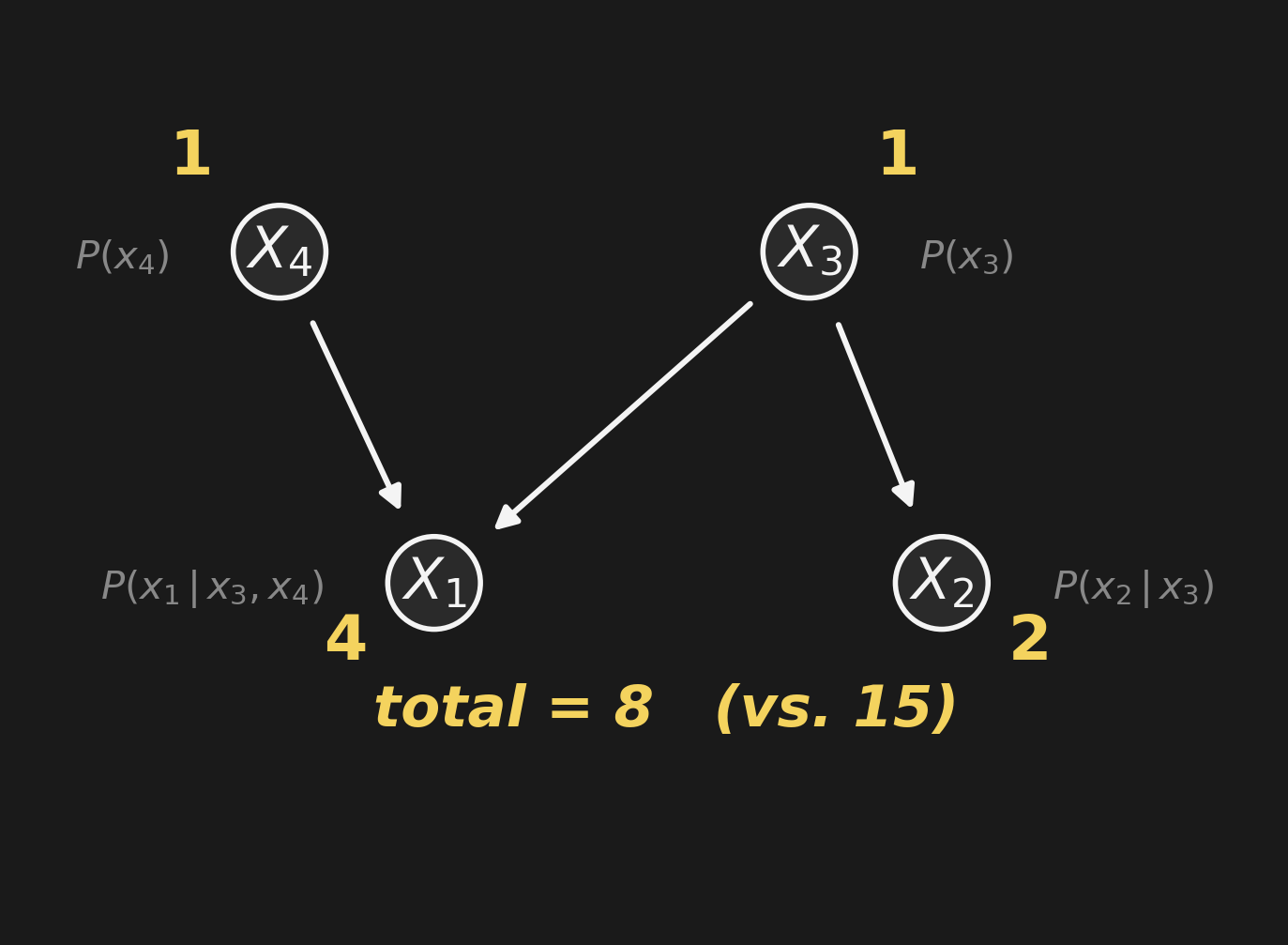
8 vs. 15. Modest gain here — exponential gain at scale.

8 個 vs. 15 個。ここでは控えめな差 — 規模が大きくなると指数的な差に。

Same network, different costume同じネット、違う衣装

Chibany versionチバニー版
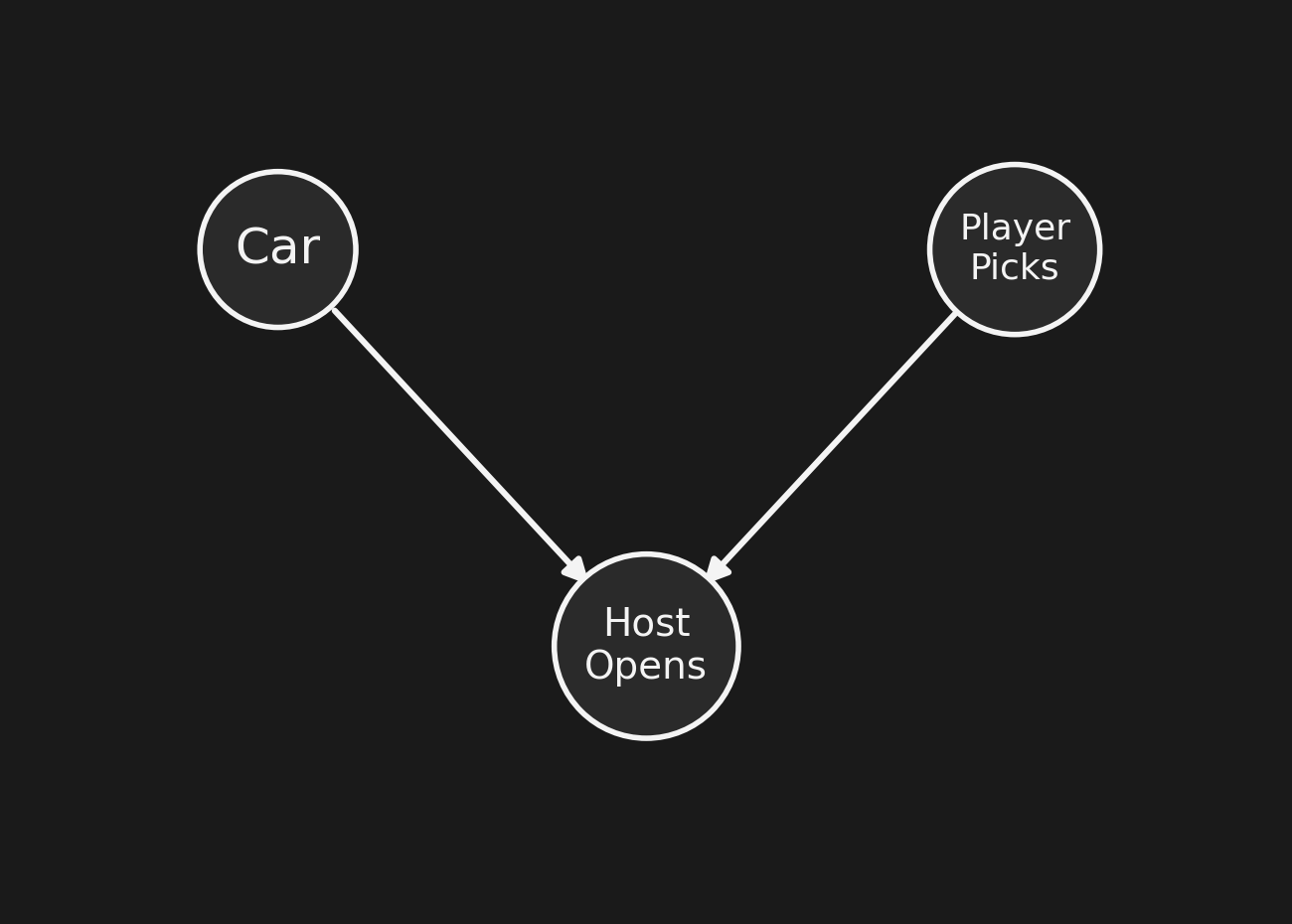
Classic Monty Hall古典的なモンティ・ホール

Car / Host / Player and Tonkatsu / Cafeteria / Chibany — literally the same network. The 2/3 vs 1/3 answer is structural.

車 / ホスト / プレイヤー と トンカツ / 店員 / チバニー — 文字通り 同じネットワーク。 2/3 vs 1/3 の答えはネットワーク構造から来る。

Poll — Bayes-net factorizationポール — ベイズネット因数分解

In the Chibany Monty Hall network (Tonkatsu → Reveals ← Chooses), the joint \(P(T, R, C)\) factorizes as:

チバニーのモンティ・ホールネット(トンカツ → 公開 ← 選択)において、 同時分布 \(P(T, R, C)\) の因数分解は:

  • A. \(P(T) \, P(C) \, P(R \mid T, C)\)
  • B. \(P(T \mid C) \, P(C) \, P(R)\)
  • C. \(P(T) \, P(C \mid T) \, P(R \mid C)\)
  • D. Cannot factorize — all three are dependent.
  • A. \(P(T) \, P(C) \, P(R \mid T, C)\)
  • B. \(P(T \mid C) \, P(C) \, P(R)\)
  • C. \(P(T) \, P(C \mid T) \, P(R \mid C)\)
  • D. 因数分解できない — 3つすべて従属。

Poll — answerポール — 答え

A. \(P(T) \, P(C) \, P(R \mid T, C)\)A. \(P(T) \, P(C) \, P(R \mid T, C)\)

Each node, given its parents, contributes one factor. \(T\) and \(C\) are root nodes (no parents) → marginals. \(R\) is a child of both → conditional on both.

各ノードは、その親ノードに条件付けられた因子を1つ提供する。 \(T\)\(C\) は根ノード(親なし)→ 周辺確率。 \(R\) は両方の子 → 両方に条件付けられた条件付き確率。

d-separation + Bayes-Balld分離 + ベイズボール

Reading independence off the graphグラフから独立性を読み取る

The Markov factorization tells us how the joint factors. But what about conditional independence?

Three patterns to know — every Bayes net is built from these:

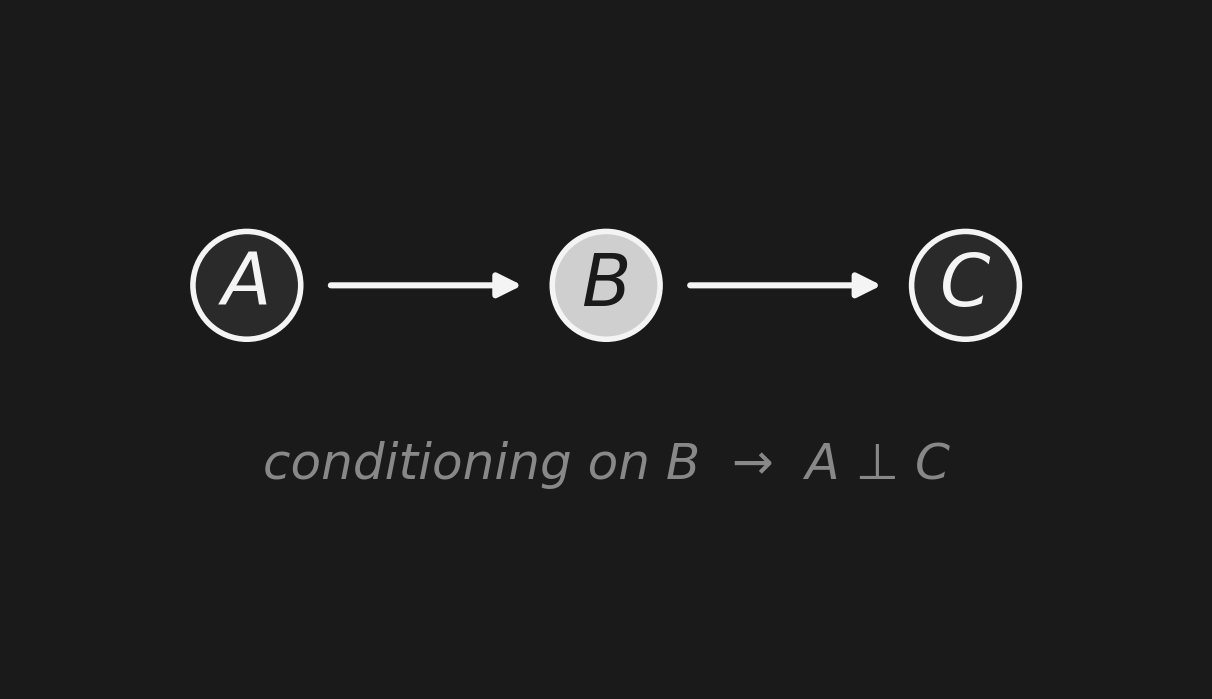
  • Chain: \(A \to B \to C\)
  • Fork: \(A \leftarrow B \to C\)
  • Collider: \(A \to B \leftarrow C\)

Conditioning on \(B\) behaves differently in each.

マルコフ因数分解は、同時分布の 因数分解 を教えてくれます。 では 条件付き独立性 はどうでしょうか?

3つのパターン — どのベイズネットもこれらから組み立てられている:

  • チェーン(鎖): \(A \to B \to C\)
  • フォーク(分岐): \(A \leftarrow B \to C\)
  • コライダー(合流): \(A \to B \leftarrow C\)

\(B\) に条件付けるとき、それぞれ 違う 振る舞いをします。

Chain: A → B → Cチェーン: A → B → C

Conditioning on the middle node blocks information flow.

\[A \;\perp\; C \;\mid\; B\]

中間ノードに条件付けると、情報の流れは 遮断 される。

\[A \;\perp\; C \;\mid\; B\]

Fork: A ← B → Cフォーク: A ← B → C
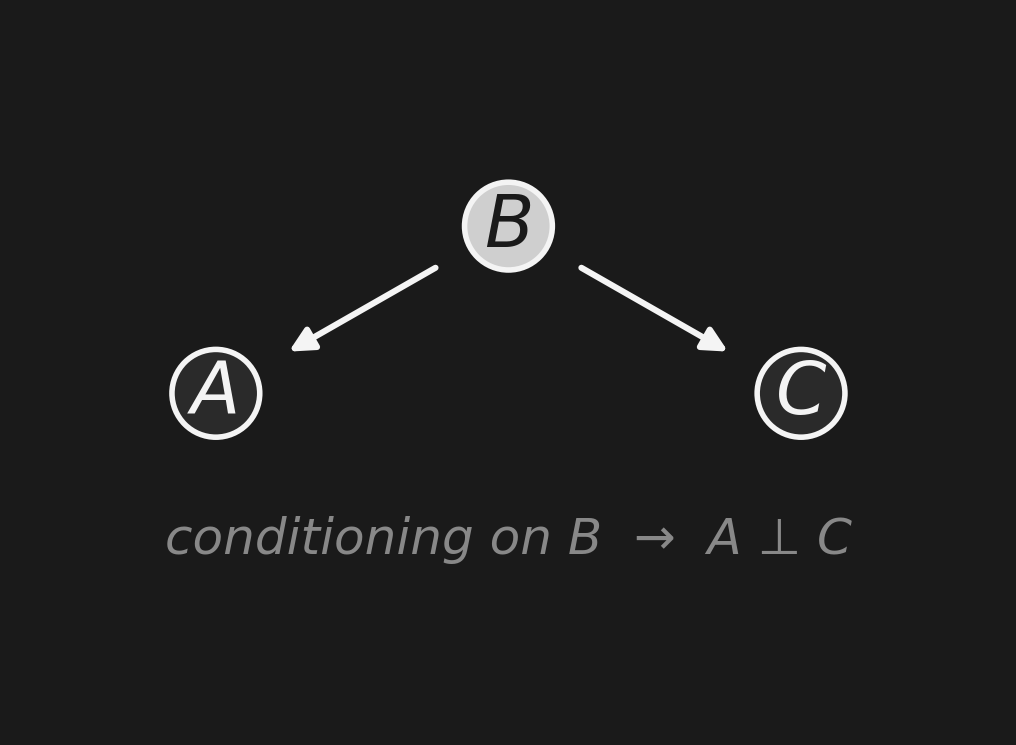
A common cause. Conditioning on the cause blocks information flow.

\[A \;\perp\; C \;\mid\; B\]

共通原因。原因に条件付けると、情報の流れは 遮断 される。

\[A \;\perp\; C \;\mid\; B\]

Collider: A → B ← Cコライダー: A → B ← C
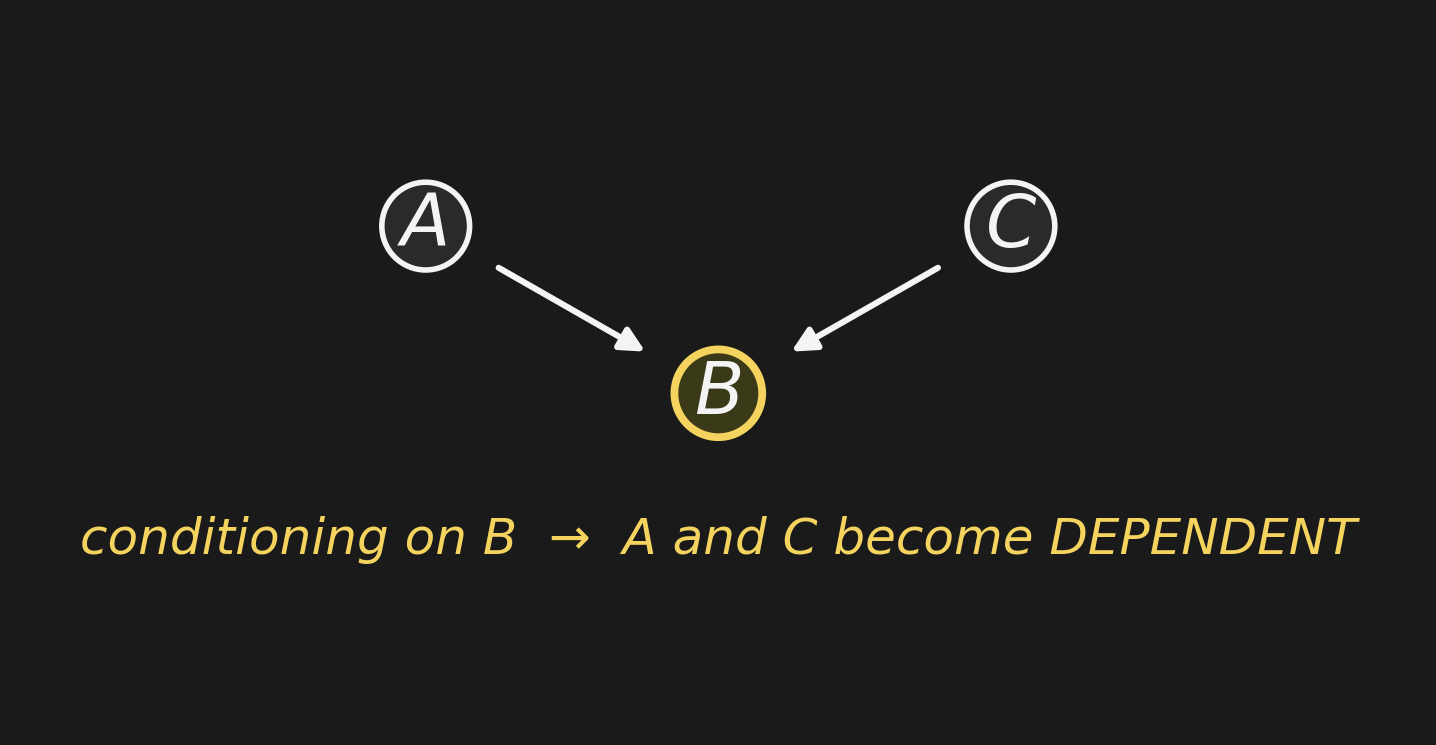
A common effect. Conditioning on the effect induces dependence between the otherwise-independent causes.

\[A \;\perp\; C \quad\text{but}\quad A \;\not\perp\; C \;\mid\; B\]

This is backwards from chain and fork. It’s the surprise of the lecture.

共通の結果。結果に条件付けると、もともと独立だった原因間に依存性が 生じる

\[A \;\perp\; C \quad\text{しかし}\quad A \;\not\perp\; C \;\mid\; B\]

これはチェーンやフォークと 逆向き。今日の講義の意外なポイント。

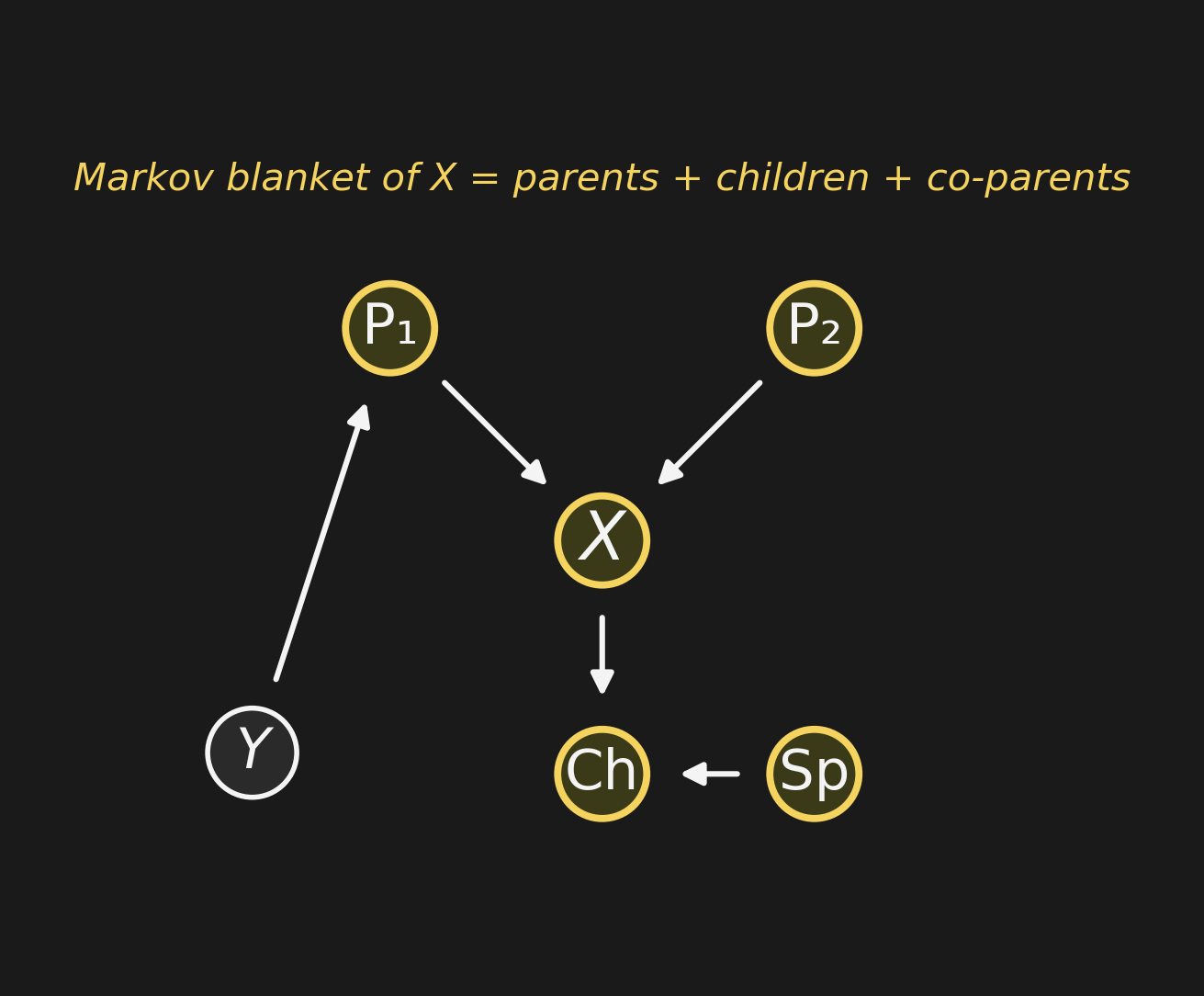
Markov blanketマルコフブランケット

Definition. The Markov blanket of node \(X\):

  • parents of \(X\)
  • children of \(X\)
  • other parents of \(X\)’s children (the “spouses”)

Conditioning on the Markov blanket makes \(X\) independent of everything else in the network.

The spouses are the non-obvious part — they’re there because of collider conditioning flowing through \(X\)’s children.

定義. ノード \(X\) のマルコフブランケット:

  • \(X\)
  • \(X\)
  • \(X\) の子の 他の親(「配偶者」)

マルコフブランケットに条件付けると、\(X\) はネットワーク中の 他のすべてから独立 になる。

配偶者は自明でないところ — \(X\) の子を通って流れる コライダーへの条件付け のために含まれる。
Bayes-Ball: interactive demoベイズボール:インタラクティブデモ

Poll — collider conditioningポール — コライダーの条件付け

You see the cafeteria worker reveal a bento (not Chibany’s pick, not tonkatsu). You haven’t been told which bento Chibany picked. Does the worker’s choice tell you anything about Chibany’s pick?

店員がお弁当を1つ公開する(チバニーの選択でもなく、トンカツでもない)。 チバニーがどれを選んだかはまだ知らない。店員の選択は、チバニーの選択について 何か教えてくれるだろうか?

  • A. Yes — the worker’s choice and Chibany’s pick become dependent.
  • B. No — they were independent before, so they’re still independent.
  • C. Only if you also know which bento has the tonkatsu.
  • D. Chibany’s pick was random, so nothing tells you about it.
  • A. はい — 店員の選択とチバニーの選択は従属になる。
  • B. いいえ — もともと独立だったので、今も独立。
  • C. トンカツの位置も知っている場合のみ。
  • D. チバニーの選択はランダムなので、何も教えてくれない。

Poll — answerポール — 答え

A. Yes — collider conditioning induces dependence.A. はい — コライダーの条件付けは依存性を生み出す。

The worker’s choice constrains Chibany’s pick: if the worker opened box 3, Chibany must have picked box 1 or 2 (otherwise the worker would have opened something else). The choices are now correlated through the constraint.

This is explaining away — Block 5.

店員の選択はチバニーの選択を制約する:店員が3番を開けたなら、 チバニーは1番か2番を選んだに違いない(さもなければ店員は別の箱を開けたはず)。 2つの選択は制約 を通じて 相関する。

これが 説明はがし — ブロック5。

Explaining away説明はがし

Sprinkler / Rain / Wet grassスプリンクラー / 雨 / 濡れた芝生
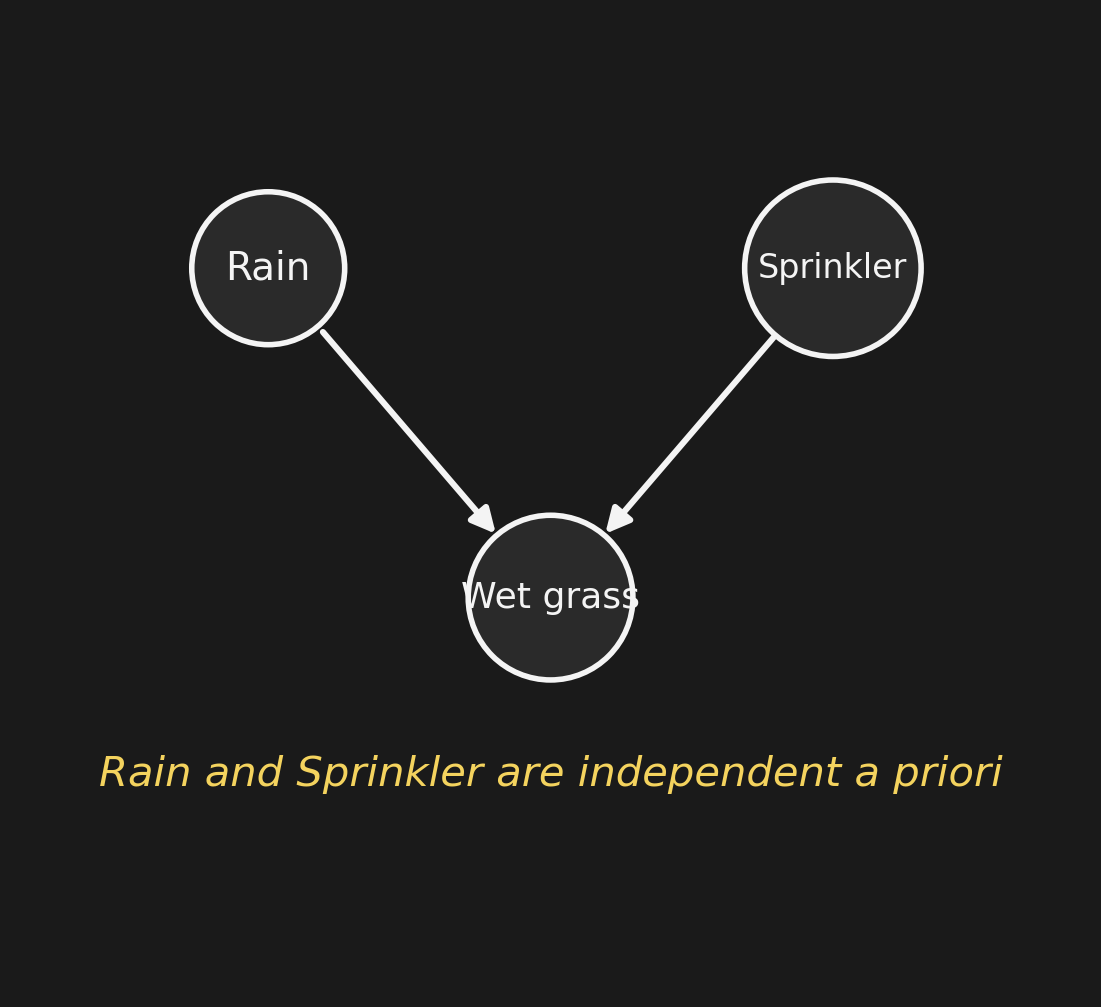
Three nodes: Rain (\(R\)), Sprinkler (\(S\)), Wet grass (\(W\)). Two independent causes of wet grass. A priori, \[P(R) = 0.3, \quad P(S) = 0.3, \quad P(R, S) = P(R)\,P(S).\] Rain and Sprinkler are independent. The grass is wet if either cause fires: \[W = 1 \iff (R = 1)\ \text{or}\ (S = 1). \quad\text{(deterministic OR)}\]

\(R\), \(S\), \(W\) from here on.

3つのノード: (\(R\))、スプリンクラー (\(S\))、濡れた芝生 (\(W\))。濡れた芝生の独立な2つの原因。事前分布は、 \[P(R) = 0.3, \quad P(S) = 0.3, \quad P(R, S) = P(R)\,P(S).\] 雨とスプリンクラーは 独立どちらか の原因が起これば芝生は濡れる: \[W = 1 \iff (R = 1)\ \text{または}\ (S = 1). \quad\text{(決定的 OR)}\]

以降、\(R\), \(S\), \(W\) と略記。

Observe wet grass濡れた芝生を観測
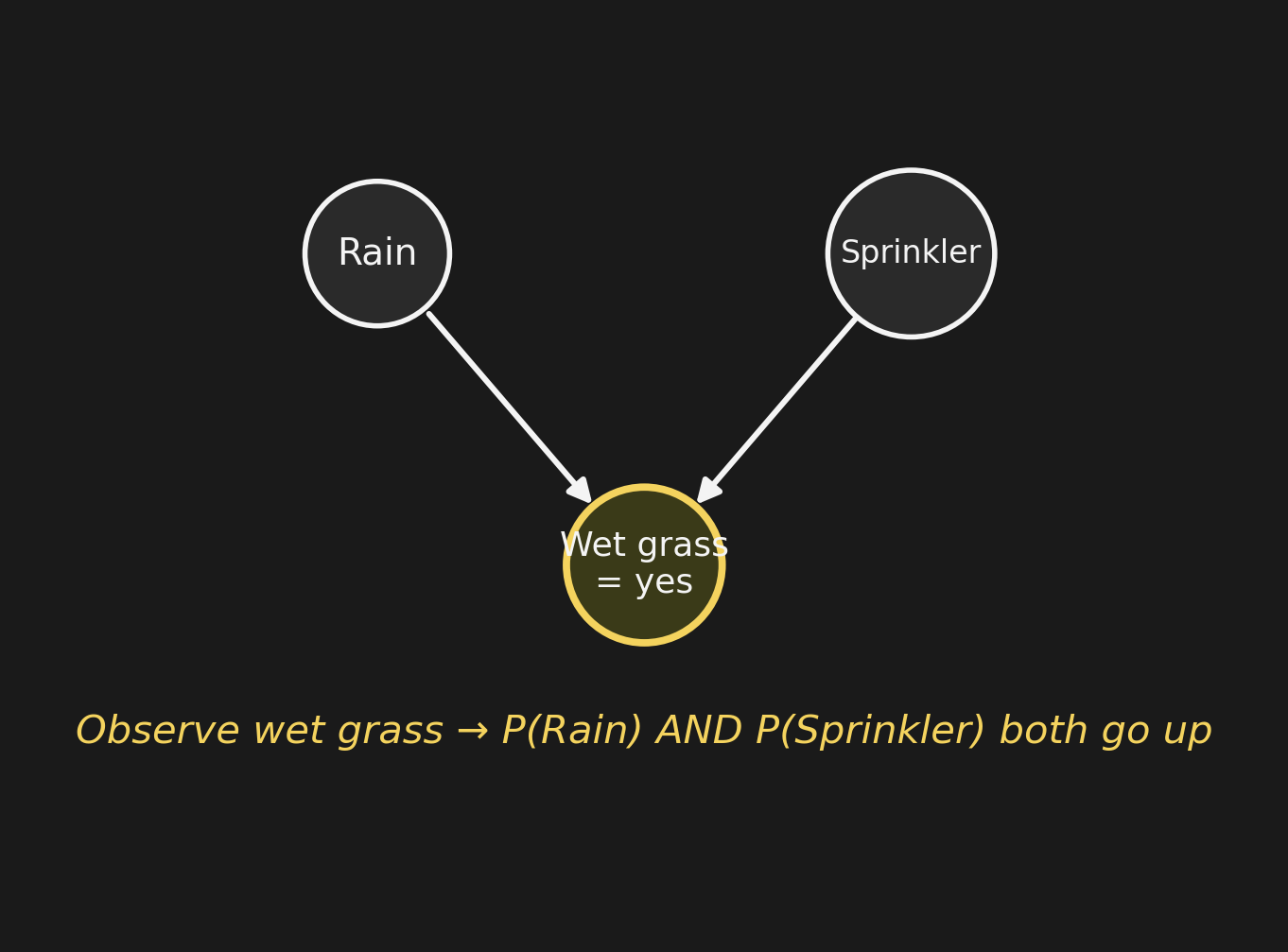
Now we walk outside: the grass is wet (\(W = 1\)). Both probabilities rise: \[P(R \mid W) \approx 0.59, \quad P(S \mid W) \approx 0.59.\] Either cause is now more plausible — the observation supports both.

さて、外に出ると:芝生が濡れている (\(W = 1\))。両方の確率が 上がる\[P(R \mid W) \approx 0.59, \quad P(S \mid W) \approx 0.59.\] どちらの原因も今や確からしくなる — 観測は両方を支持する。

Also learn sprinkler was onさらに、スプリンクラーが作動していたと知る
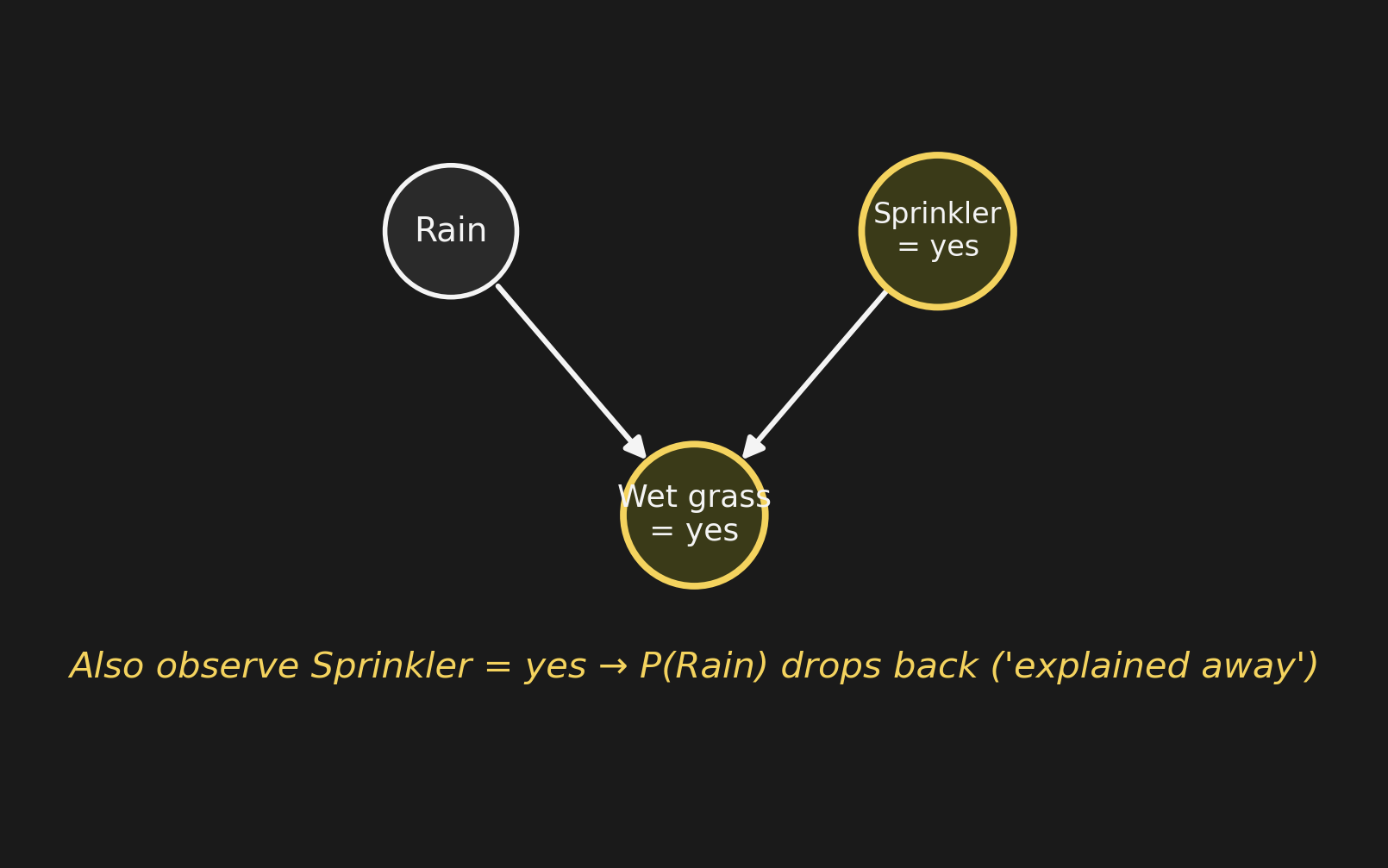
A neighbor mentions: “I saw your sprinkler running this morning.” So \(S = 1\). Now: \[P(R \mid W, S = 1) = 0.3 = P(R).\] Rain’s probability drops all the way back to its prior — sprinkler already “explains” the wetness, so wet grass tells us nothing more about rain.

Conditioning on the collider’s parents and the collider itself induces this competition. That’s explaining away.

近所の人が言う:「今朝あなたのスプリンクラーが動いているのを見たよ。」つまり \(S = 1\)。今度は: \[P(R \mid W, S = 1) = 0.3 = P(R).\] 雨の確率が 事前分布まで完全に戻る — スプリンクラーが濡れていることを既に「説明」したので、 濡れた芝生は雨について もう何も教えてくれない

コライダーの親 コライダー自身に条件付けることで、この競合が生まれる。 これが説明はがし。

What just happened今、何が起きたのか

The numbers:

Conditioning set \(P(R = 1)\)
nothing 0.30
\(W = 1\) 0.59
\(W = 1,\, S = 1\) 0.30

Rain rose, then fell back to its prior. The fall is explaining away.

数値の変化:

条件付け \(P(R = 1)\)
なし 0.30
\(W = 1\) 0.59
\(W = 1,\, S = 1\) 0.30

雨の確率は上がり、事前分布まで戻った。下がる部分が 説明はがし

The take-home in one sentence:

Conditioning on a common effect (the collider) makes the independent causes dependent. Then learning one cause reduces the support for the other.

Same mechanism, two stages.

一文でまとめると:

共通の結果(コライダー)に条件付けると、独立だった原因が 従属になる。 そして一つの原因を学ぶと、もう一つの原因への支持が 減る

同じメカニズム、2つの段階。

Why Chibany should switch — explainedチバニーが箱を変えるべき理由 — 説明はがしで

Remember Monty Hall? Tonkatsu and Chibany’s pick were independent a priori. We then conditioned on the collider (the worker’s reveal).

That’s explaining away.

The worker had to open some box. If Chibany picked correctly (T = 1), the worker had a free choice. If Chibany picked wrong (T ≠ 1), the worker was forced to open the specific other box. The “forcing” is what makes the posterior favor switching.

モンティ・ホールを覚えていますか?トンカツとチバニーの選択は、事前には独立でした。 そして コライダー(店員の公開)に条件付けた。

それが説明はがし。

店員は どれか 箱を開けないといけない。もしチバニーが正解を選んでいたら(T = 1)、 店員には自由な選択肢があった。もし間違っていたら(T ≠ 1)、店員は特定の箱を 開けるしか なかった。この「強制」が、事後分布を「変える」方に傾けるのです。

Break休憩

Observation → intervention観測 → 介入

A claim from the dentist歯医者からの主張

Chibany is at the dentist. “People with yellow teeth,” the dentist says, “tend to have higher rates of lung cancer.”

Chibany asks: “Should I whiten my teeth?”

チバニーは歯医者で。「歯が黄色い人は」と歯医者が言う、「肺がんの率が高い傾向がある。」

チバニーが聞く:「歯を白くしたほうがいい?」

The confound共通原因(交絡)

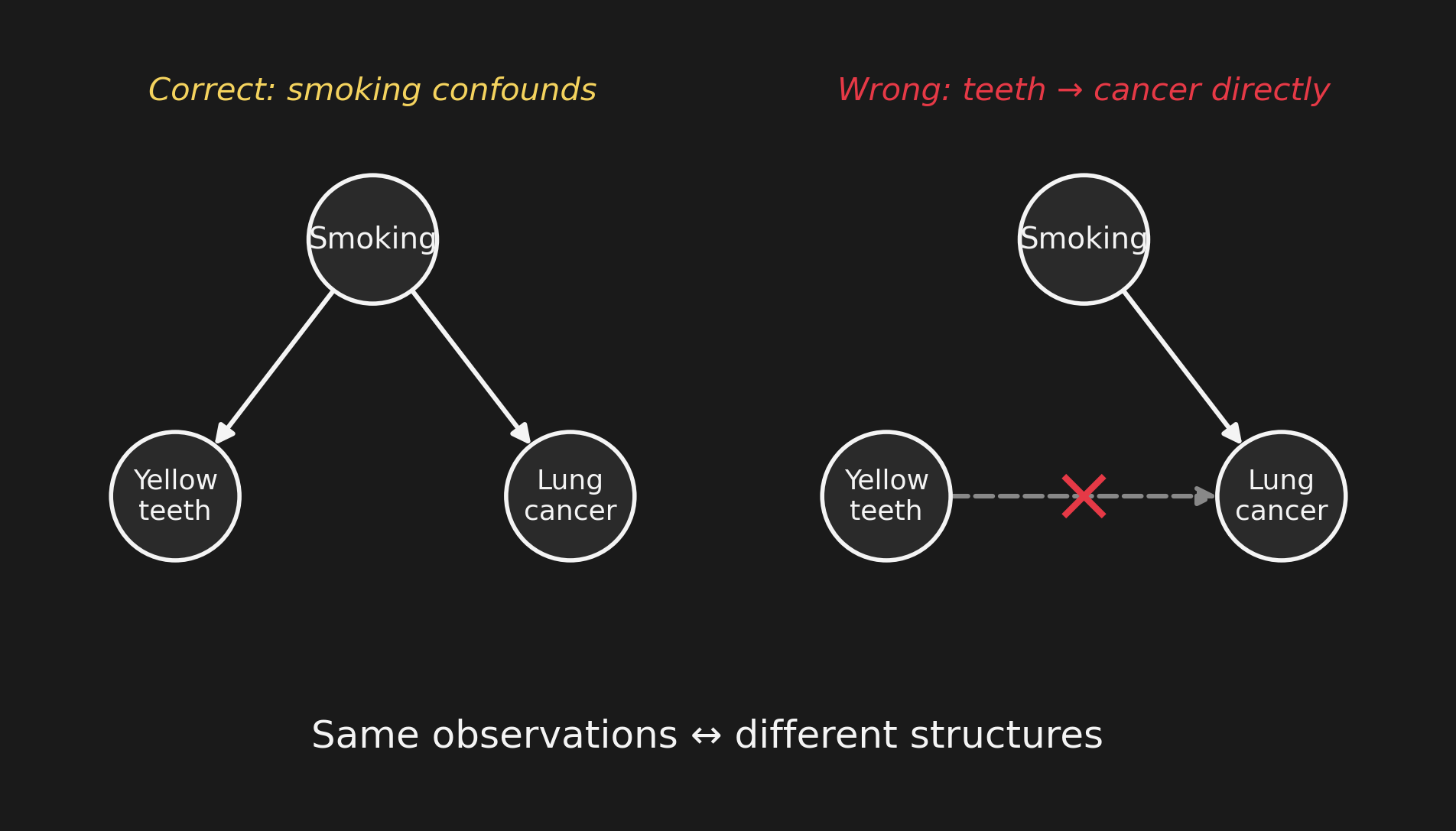
Three variables: Smoking (\(S\)), Yellow teeth (\(T\)), Lung cancer (\(L\)). Two structures give exactly the same statistical correlation:

  • \(S\) causes both \(T\) and \(L\) (correct).
  • \(T\) directly causes \(L\) (wrong, but observationally indistinguishable).

Observation alone cannot tell them apart. You’d see the same correlation either way.

\(S\), \(T\), \(L\) from here on.

3つの変数:喫煙 (\(S\))、黄色い歯 (\(T\))、肺がん (\(L\))。2つの構造が まったく同じ 統計的相関を生む:

  • \(S\)\(T\)\(L\) の両方の原因(正しい)。
  • \(T\) が直接 \(L\) を引き起こす(誤りだが、観測上は区別できない)。

観測だけではこの2つを区別できません。 どちらの構造でも同じ相関が見られる。

以降、\(S\), \(T\), \(L\) と略記。

Three causal stories, one correlation: chain1つの相関、3つの因果ストーリー:チェーン

Story 1 (chain): \(T \to S \to L\) — yellow teeth cause smoking, smoking causes lung cancer. Implausible, but observationally consistent.

Conditional independence: \(T \perp L \mid S\).

ストーリー1(チェーン): \(T \to S \to L\) — 黄色い歯が喫煙の原因で、 喫煙が肺がんの原因。実際にはありそうにないが、観測上は整合的。

条件付き独立性: \(T \perp L \mid S\)

Three causal stories, one correlation: fork1つの相関、3つの因果ストーリー:フォーク

Story 2 (fork): \(T \leftarrow S \to L\) — smoking causes both. The real story for the smoking-yellow-teeth-cancer triangle.

Conditional independence: \(T \perp L \mid S\).

Identical to chain! Observation cannot tell these apart.

ストーリー2(フォーク): \(T \leftarrow S \to L\) — 喫煙が両方の原因。 喫煙-黄色い歯-肺がんの三角関係の 本当の ストーリー。

条件付き独立性: \(T \perp L \mid S\)

チェーンと同一! 観測ではこの2つを区別できません。

Three causal stories, one correlation: collider1つの相関、3つの因果ストーリー:コライダー

Story 3 (collider): \(T \to S \leftarrow L\) — yellow teeth and lung cancer each independently cause smoking (also implausible, but bear with it).

Conditional dependence: \(T \not\perp L \mid S\).

Observationally distinct — but the wrong structure for a smoking confound. Most real-world confounds are forks, indistinguishable from chains.

ストーリー3(コライダー): \(T \to S \leftarrow L\) — 黄色い歯と肺がんが それぞれ独立に喫煙の原因(これもありそうにないが、お付き合いください)。

条件付き従属性: \(T \not\perp L \mid S\)

観測で区別できる — しかし、喫煙の交絡には合わない構造。 現実の交絡の多くはフォークで、チェーンとは区別できません。

What we need必要なもの

What observation tells you:

  • statistical dependence
  • joint distribution
  • can’t disambiguate chain from fork

This is Level 1 of Pearl’s ladder.

観測が教えてくれること:

  • 統計的従属性
  • 同時分布
  • チェーンとフォークの区別はつかない

これがパールの梯子の レベル1

What intervention would do:

  • cut incoming arrows
  • reveal the cause
  • break Markov equivalence

This is Level 2 — coming up next.

介入なら何ができるか:

  • 入ってくる矢印を切る
  • 原因を明らかにする
  • マルコフ同値を破る

これが レベル2 — 次に登場。

The do-operatordo演算子

The original network元のネットワーク

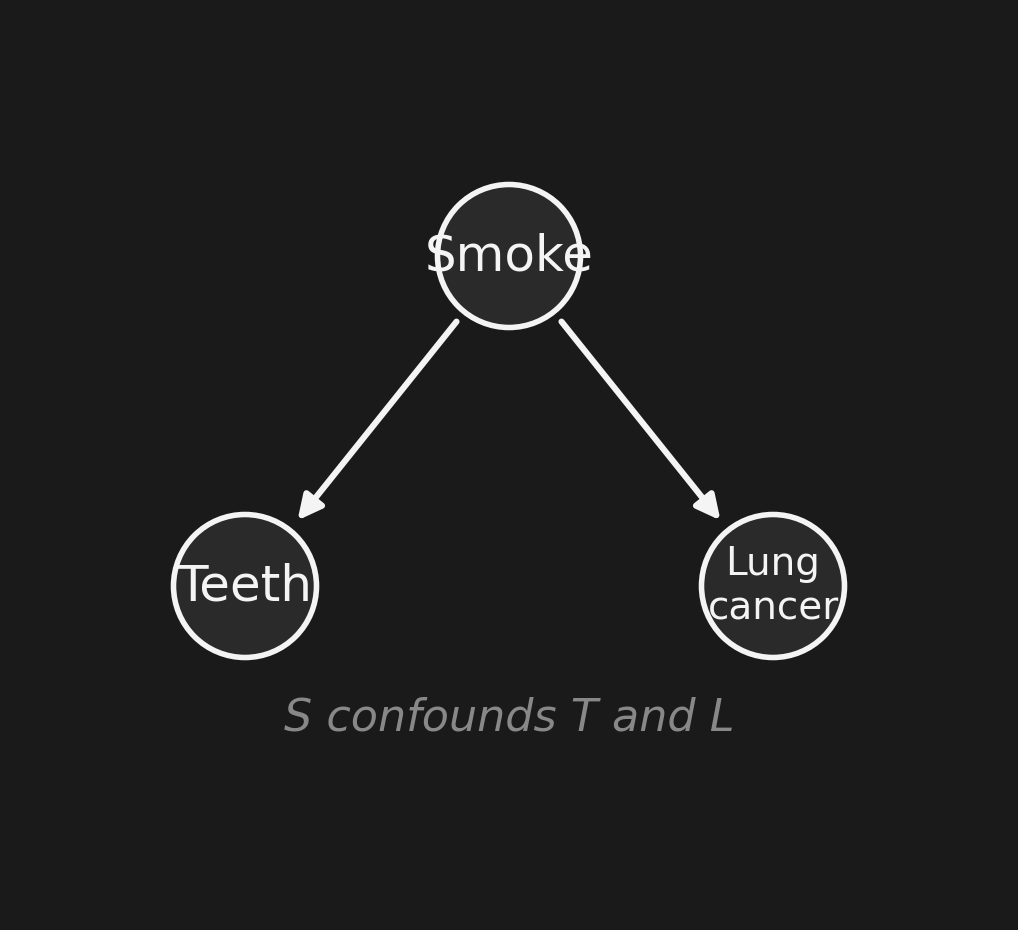
\(S \to T\) (smoking causes yellow teeth), \(S \to L\) (smoking causes lung cancer). \(T\) and \(L\) are correlated because of the common cause \(S\).

If we observe \(T = \text{yellow}\), we update our belief about \(S\), and therefore about \(L\). Hence \(P(L \mid T = \text{yellow}) > P(L)\).

\(S \to T\)(喫煙が歯を黄色くする)、\(S \to L\)(喫煙が肺がんの原因)。 \(T\)\(L\) は共通原因 \(S\) を通じて 相関する。

\(T = \text{黄色}\)観測 すると、\(S\) についての信念が更新され、 そのため \(L\) についても更新される。だから \(P(L \mid T = \text{黄色}) > P(L)\)

do(T = white): cut the incoming arrowdo(T = 白): 入ってくる矢印を切る
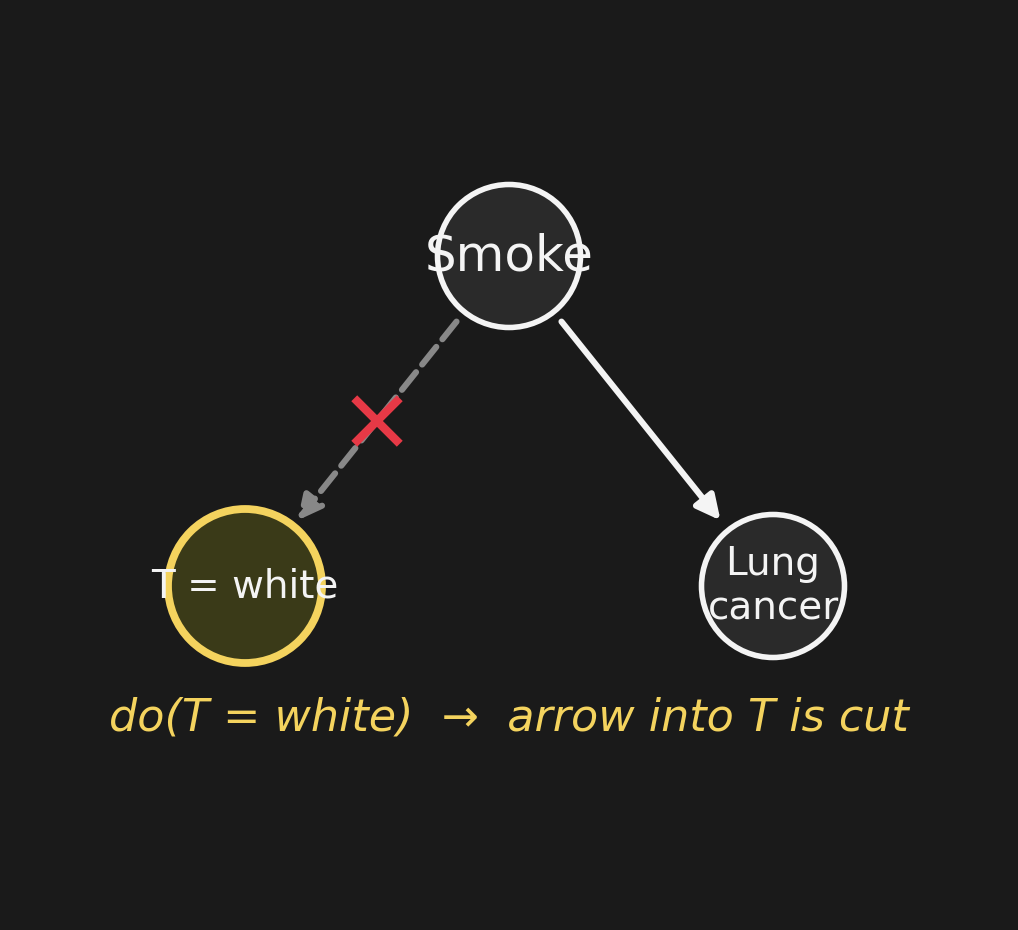
Graph surgery. We set \(T = \text{white}\) by intervention — we paid for whitening. The intervention cuts the incoming arrow \(S \to T\).

Why cut? Because \(T\) is no longer being generated by smoking. \(T\) is being generated by Chibany’s wallet. The mechanism changed.

グラフ手術. 介入によって \(T = \text{白}\) にする — 歯を白くする処置にお金を払った。 介入は 入ってくる矢印 \(S \to T\) を切断する

なぜ切る?\(T\) はもはや喫煙によって 生成されていない から。\(T\) はチバニーの財布に よって生成されている。メカニズムが変わったのです。

Compute P(L | do(T = white))P(L | do(T = 白)) を計算
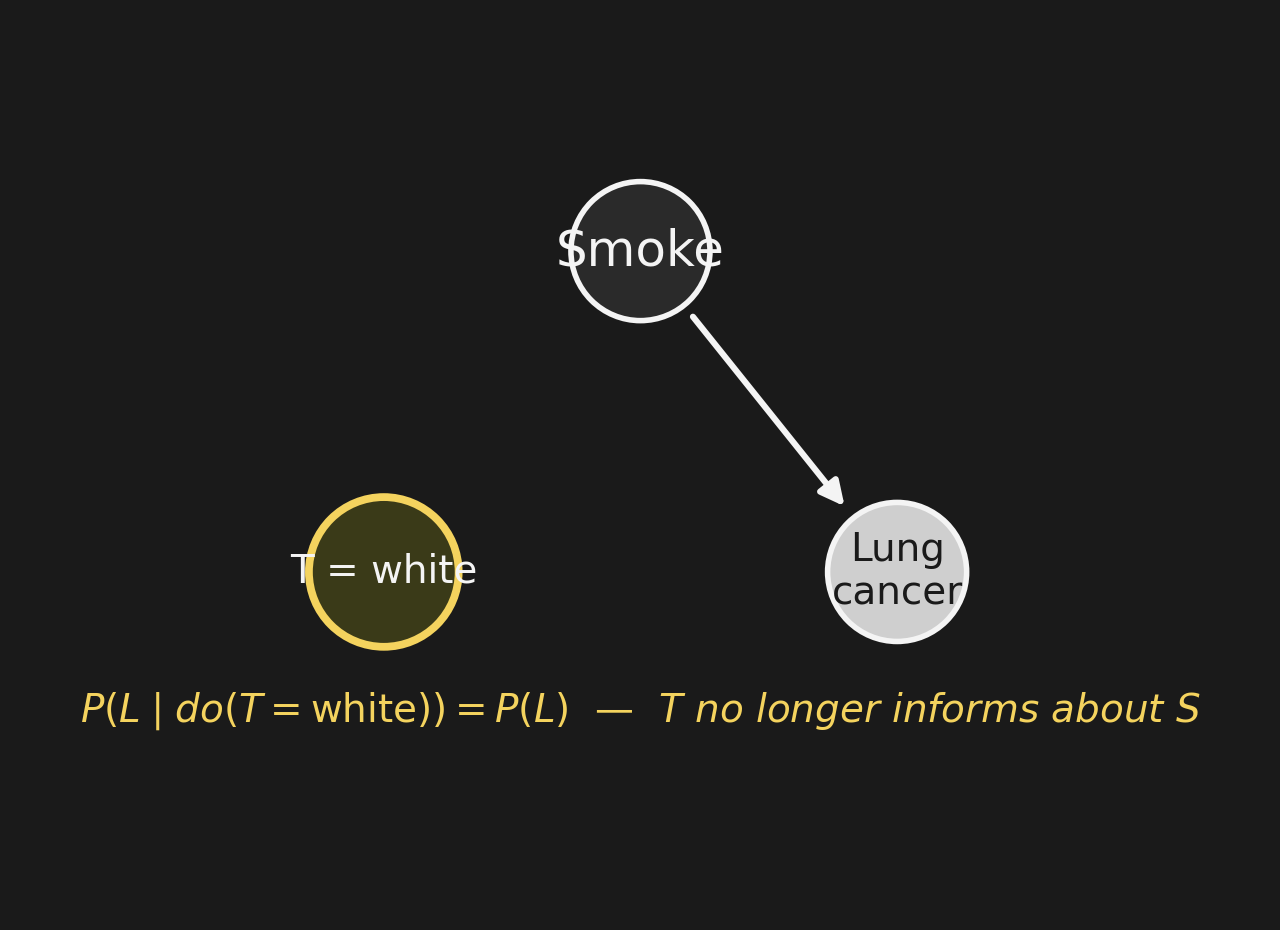
After surgery, \(T\) has no parents. The factorization becomes: \[P(S, L, T = \text{white}) = P(S) \, P(L \mid S).\]

Marginalize over \(S\) to get \(P(L \mid do(T = \text{white}))\): \[P(L \mid do(T = \text{white})) = \sum_S P(L \mid S) \, P(S) = P(L).\]

Intervention severed the path from \(T\) back to \(L\) through \(S\). \(T\) no longer carries any information about \(S\), so knowing \(T\) tells you nothing new about \(L\).

手術後、\(T\) には親がない。因数分解は次のようになる: \[P(S, L, T = \text{白}) = P(S) \, P(L \mid S).\]

\(S\) について周辺化して \(P(L \mid do(T = \text{白}))\) を得る: \[P(L \mid do(T = \text{白})) = \sum_S P(L \mid S) \, P(S) = P(L).\]

介入は \(T\) から \(S\) を経由して \(L\) へ戻る経路を断ち切った。 \(T\) はもう \(S\) について何の情報も運ばないので、\(T\) を知っても \(L\) について新しいことは何も分からない。

\(P(L \mid T)\) vs. \(P(L \mid do(T))\)\(P(L \mid T)\) vs. \(P(L \mid do(T))\)
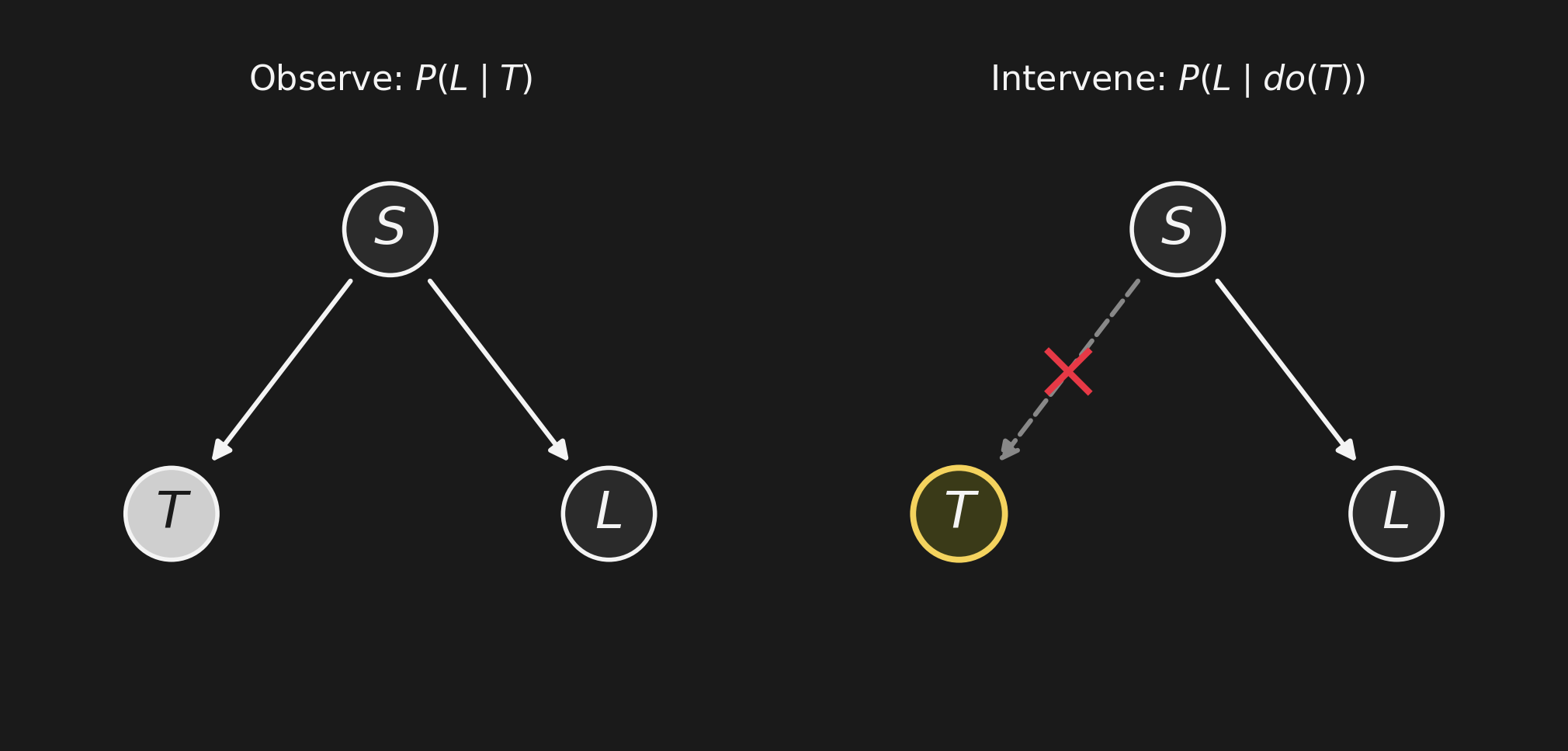
Same notation, different operation, different answer.

  • \(P(L \mid T)\): passive observation. Yellow teeth tell you about smoking.
  • \(P(L \mid do(T))\): active intervention. Yellow teeth tell you about the dentist’s bill.

同じ記号、違う操作、違う答え。

  • \(P(L \mid T)\): 受動的な観測。黄色い歯は喫煙について教えてくれる。
  • \(P(L \mid do(T))\): 能動的な介入。黄色い歯は歯科医の請求書について教えてくれる。

Poll — do vs. conditionポール — do vs. 条件付け

In the smoking network \(S \to T, S \to L\), Chibany pays to whiten their teeth (intervention: \(T = \text{white}\)).

What is \(P(\text{lung cancer} \mid do(T = \text{white}))\)?

喫煙ネットワーク \(S \to T, S \to L\) で、チバニーがお金を払って歯を白くする (介入:\(T = \text{白}\))。

\(P(\text{肺がん} \mid do(T = \text{白}))\) は?

  • A. Lower than \(P(\text{lung cancer})\) — white teeth predict less smoking.
  • B. Same as \(P(\text{lung cancer})\) — intervention cuts the \(S \to T\) edge.
  • C. Higher than \(P(\text{lung cancer})\) — paint chemicals are toxic.
  • D. Unknown without more data.
  • A. \(P(\text{肺がん})\) より低い — 白い歯は喫煙の少なさを予測する。
  • B. \(P(\text{肺がん})\) と同じ — 介入は \(S \to T\) の辺を切る。
  • C. \(P(\text{肺がん})\) より高い — 塗料の化学物質は有毒。
  • D. データが足りない。

Poll — answerポール — 答え

B. Same as \(P(\text{lung cancer})\).B. \(P(\text{肺がん})\) と同じ。

The intervention cuts the \(S \to T\) edge. \(T\) no longer informs about \(S\), and the path from \(T\) to \(L\) (which went through \(S\)) is severed.

(A) is the trap — it’s the right answer if you observe \(T\), but the wrong answer if you intervene on \(T\).

介入は \(S \to T\) の辺を切る。\(T\) はもう \(S\) について何も教えてくれず、 \(T\) から(\(S\) を経由して)\(L\) への経路は断ち切られた。

(A) は罠\(T\)観測 するなら正しい答え、\(T\)介入 するなら間違った答え。

Causal cognition — the blicket detector因果認知 — ブリケット検出器

The blicket detectorブリケット検出器

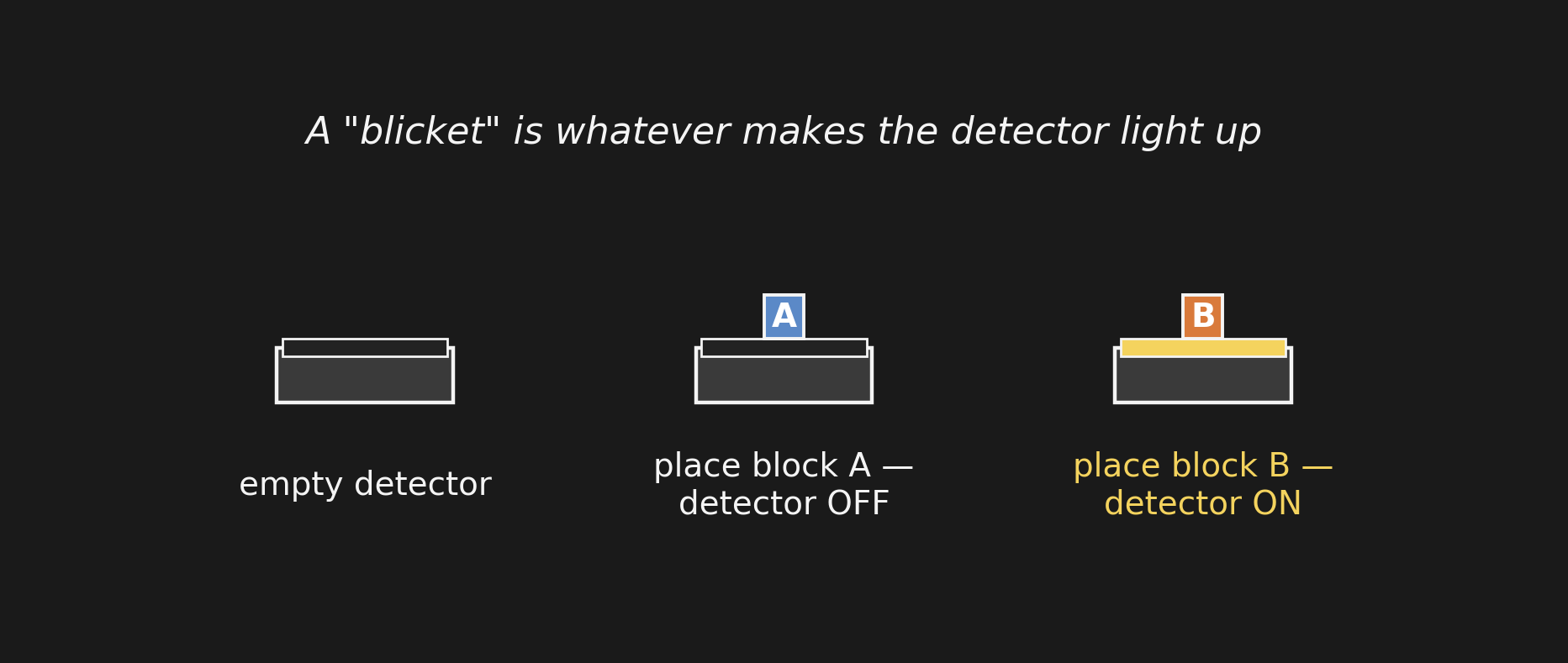
A children’s experiment (Gopnik & Sobel, 2000). A “blicket” is whatever makes the machine light up. Children watch blocks placed on the detector and infer which blocks are blickets.

子ども向けの実験(ゴプニックとソベル、2000)。「ブリケット」とは、機械を光らせる ものすべて。子どもは積み木が検出器に置かれるのを見て、どの積み木がブリケットかを推論する。

The experiment as a Bayes netベイズネットとしての実験

The physical setup:

  • A machine (“detector”) that lights up.
  • A collection of blocks. Each block is or isn’t a blicket.
  • Place blocks on the machine; observe whether it lights up.

The child’s job: figure out which blocks are blickets.

物理的な構造:

  • 光る機械(「検出器」)。
  • いくつかの積み木。各積み木はブリケットかそうでないか。
  • 積み木を機械に置く;光るかどうかを観測。

子どもの仕事:どの積み木がブリケットかを見つけ出す。

The Bayes net:

For two blocks \(A\), \(B\):

  • \(A\)-blicket? → Detector lights
  • \(B\)-blicket? → Detector lights

A collider: detector is the common effect.

Each trial conditions on the collider. Inference is explaining away.

ベイズネット:

積み木 \(A\)\(B\) について:

  • \(A\) はブリケット? → 検出器が光る
  • \(B\) はブリケット? → 検出器が光る

コライダー:検出器が共通の結果。

各試行は コライダーへの条件付け。 推論は 説明はがし

Backwards blockingバックワード・ブロッキング

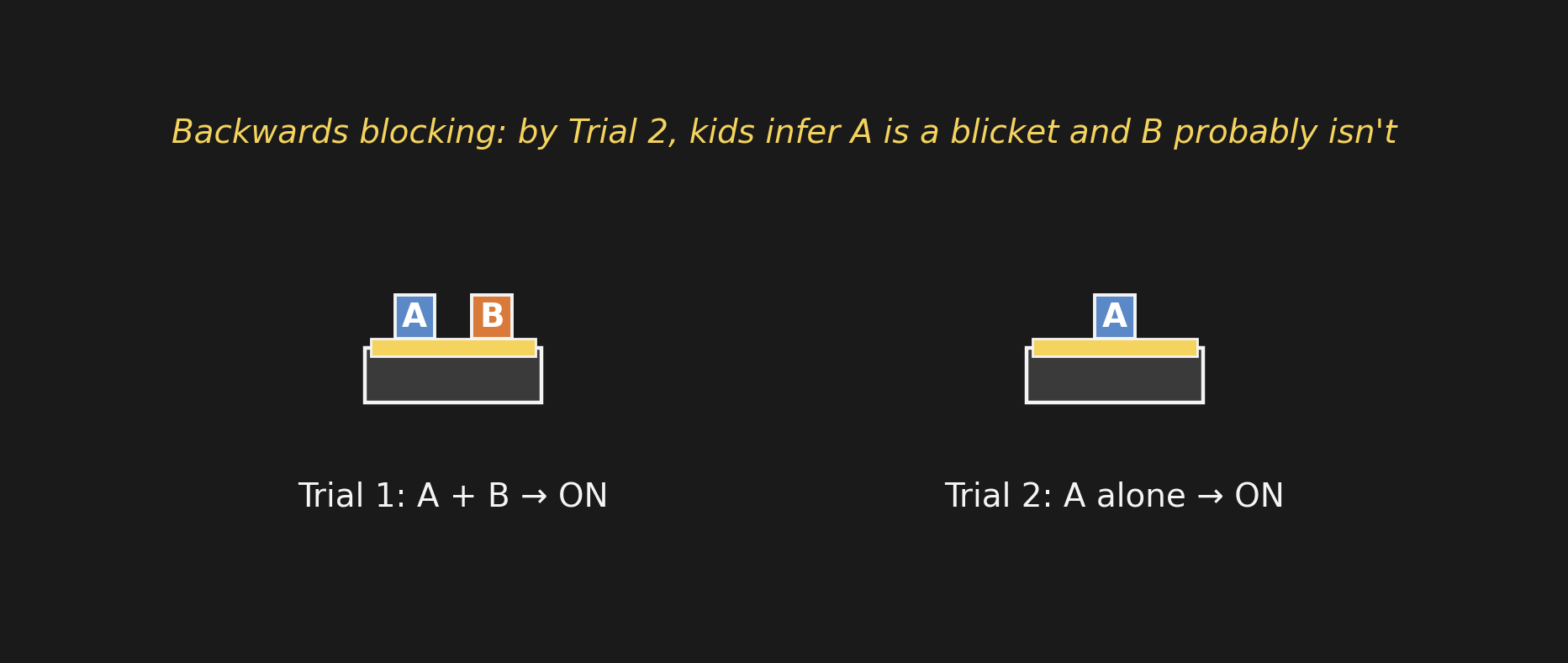
  • Trial 1: A and B together → detector ON.
  • Trial 2: A alone → detector ON.

After Trial 2, what do kids think about B?

  • 試行1: AとBを一緒に → 検出器 ON。
  • 試行2: Aだけ → 検出器 ON。

試行2の後、子どもはBについてどう思う?

Children match the Bayes net子どもはベイズネットと一致する
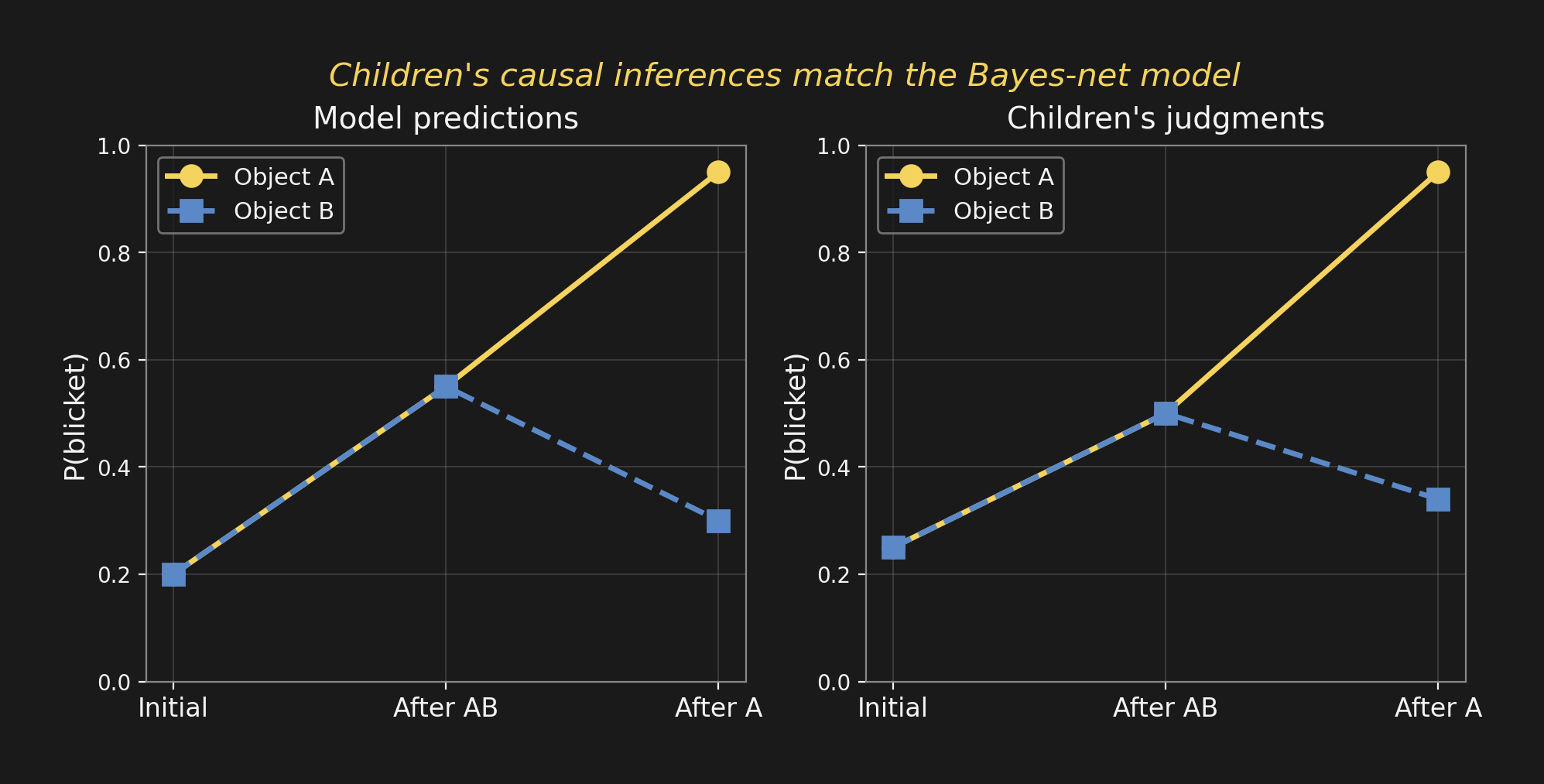
Children’s judgments drop for object B after the A-alone trial — even though nothing changed about B’s data. Children do graph surgery. They reason about the causal structure, not just statistical patterns.

The formal machinery isn’t just for engineers.

子どもの判断は、Aだけの試行のあとBについて 下がる — Bのデータについては 何も変わっていないのに。子どもはグラフ手術をしている。 統計パターンだけでなく、 因果構造について推論しているのです。

この形式的な仕組みは、エンジニアだけのものではありません。

Did the prior come back?事前は戻ってくるか?
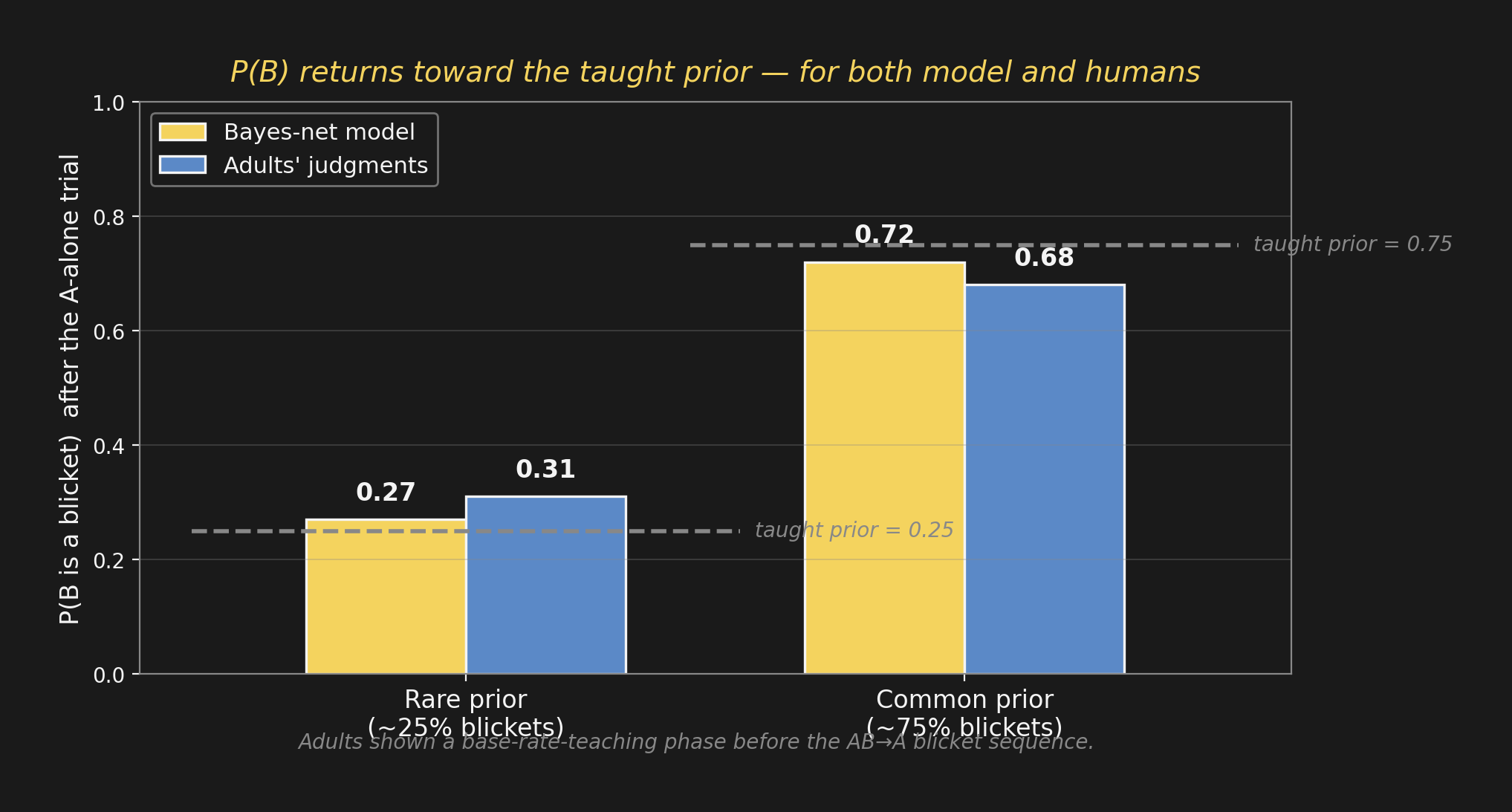
Design. Before the AB→A blicket sequence, adults watch a base-rate-teaching phase showing ~25% (“rare prior”) or ~75% (“common prior”) of arbitrary blocks are blickets. Then they run the classic backwards-blocking trials and rate \(P(B)\).

Bayes-net prediction. After A alone explains the AB result, the posterior on \(B\) should relax back toward the taught prior. Associative learning predicts a uniformly low rating regardless.

Result. Both the model AND adults snap \(P(B)\) back to the taught base rate — strong evidence that adults are reasoning Bayesianly over a causal graph, not just learning associations.

設計: AB→A の試行の前に、大人は「任意のブロックがブリケットである率」が ~25%(rare 事前)か ~75%(common 事前)かを学習する映像を見る。その後、定番の後方ブロッキング試行を行い \(P(B)\) を評価する。

ベイズネットの予測: A だけの試行が AB の結果を「説明」した後、\(B\) の事後分布は 教えられた事前に戻る。連合学習の予測は、教えた率に関係なく一律に低い評価。

結果: モデルも大人も \(P(B)\) を教えられた基準率に戻す — 大人は連合ではなく、因果グラフ上で ベイズ的に 推論している強い証拠。

Information theory + close情報理論 + まとめ

Entropy as expected surpriseエントロピー:期待される驚き

Define the surprise of seeing event \(X = x\) as

\[\text{surprise}(x) \;=\; \log \frac{1}{P(x)} \;=\; -\log P(x).\]

Smaller probability → larger surprise. The minus sign is there because \(\log P(x) \le 0\) when \(P(x) \le 1\), so \(-\log P(x) \ge 0\) — surprise is non-negative.

Event probability Surprise (bits)
\(P(x) = 1\) (certain) \(0\)
\(P(x) = 1/2\) (fair coin) \(1\)
\(P(x) = 0.01\) (rare) \(\approx 6.6\)

Entropy \(H(X)\) is the expected surprise:

\[H(X) \;=\; \sum_x P(x) \cdot \big[-\log P(x)\big] \;=\; \mathbb{E}\!\left[-\log P(X)\right].\]

事象 \(X = x\) を観測したときの 驚き を次のように定義する:

\[\text{驚き}(x) \;=\; \log \frac{1}{P(x)} \;=\; -\log P(x).\]

確率が小さいほど驚きが大きい。マイナス符号は、\(P(x) \le 1\) のとき \(\log P(x) \le 0\) なので、\(-\log P(x) \ge 0\) — 驚きが非負になるように。

事象の確率 驚き (ビット)
\(P(x) = 1\)(確実) \(0\)
\(P(x) = 1/2\)(公正なコイン) \(1\)
\(P(x) = 0.01\)(まれ) \(\approx 6.6\)

エントロピー \(H(X)\) は驚きの 期待値

\[H(X) \;=\; \sum_x P(x) \cdot \big[-\log P(x)\big] \;=\; \mathbb{E}\!\left[-\log P(X)\right].\]

Mutual information相互情報量

How much does knowing \(Y\) reduce uncertainty about \(X\)? \[I(X; Y) \;=\; H(X) - H(X \mid Y)\]

Properties:

  • \(I(X; Y) \geq 0\) always.
  • \(I(X; Y) = 0 \iff X \perp Y\).
  • \(I(X; Y) = I(Y; X)\) — symmetric.

Conditional version: \[I(X; Y \mid Z) = H(X \mid Z) - H(X \mid Y, Z).\] \(X \perp Y \mid Z\) iff \(I(X; Y \mid Z) = 0\).

\(Y\) を知ることは、\(X\) についての不確実性をどれだけ減らすか? \[I(X; Y) \;=\; H(X) - H(X \mid Y)\]

性質:

  • \(I(X; Y) \geq 0\) 常に。
  • \(I(X; Y) = 0 \iff X \perp Y\)
  • \(I(X; Y) = I(Y; X)\) — 対称。

条件付き版: \[I(X; Y \mid Z) = H(X \mid Z) - H(X \mid Y, Z).\] \(X \perp Y \mid Z\)\(I(X; Y \mid Z) = 0\) と同値。

The collider, in info-theoretic clothingコライダー、情報理論で

Take the Sprinkler / Rain / Wet-Grass collider:

  • \(I(\text{Rain}; \text{Sprinkler}) = 0\) — independent a priori.
  • \(I(\text{Rain}; \text{Sprinkler} \mid \text{Wet}) > 0\) — dependent after conditioning.

Conditioning on a collider creates mutual information from nothing.

That’s explaining away — viewed through a different lens. Info theory and Bayes nets are two languages describing the same structural facts.

スプリンクラー / 雨 / 濡れた芝生 のコライダーを考える:

  • \(I(\text{雨}; \text{スプリンクラー}) = 0\) — 事前には独立。
  • \(I(\text{雨}; \text{スプリンクラー} \mid \text{濡れた}) > 0\) — 条件付け後は従属。

コライダーへの条件付けは、無から相互情報量を生み出す。

これが説明はがし — 別の視点から見たもの。情報理論とベイズネットは、 同じ構造的事実を記述する2つの言語です。

Next week — Week 6来週 — 第6週

Markov chains + networks. Random walks. Memory search.

Reading: Abbott, Austerweil & Griffiths (2012) — Human memory search as a random walk in a semantic network.

We’ve spent today on the structure of multi-variable distributions. Next week we walk on a network instead of conditioning on one.

マルコフ連鎖とネットワーク。 ランダムウォーク。記憶検索。

読み物: Abbott, Austerweil & Griffiths (2012) — Human memory search as a random walk in a semantic network.

今日はマルチ変数分布の 構造 について学びました。 来週はネットワークに条件付ける代わりに、その上を 歩く

Thanksありがとうございました

Questions?

Office hours: by appointment. Slack me.

Reflections due before next Friday — pick any required or optional reading from this week. 5 of 11 across the semester.

質問は?

オフィスアワー:予約制。Slack でご連絡を。

リフレクションは次の金曜日までに — 今週の必須または推薦の読み物どれでもOK。 学期を通して 11 回中 5 回。