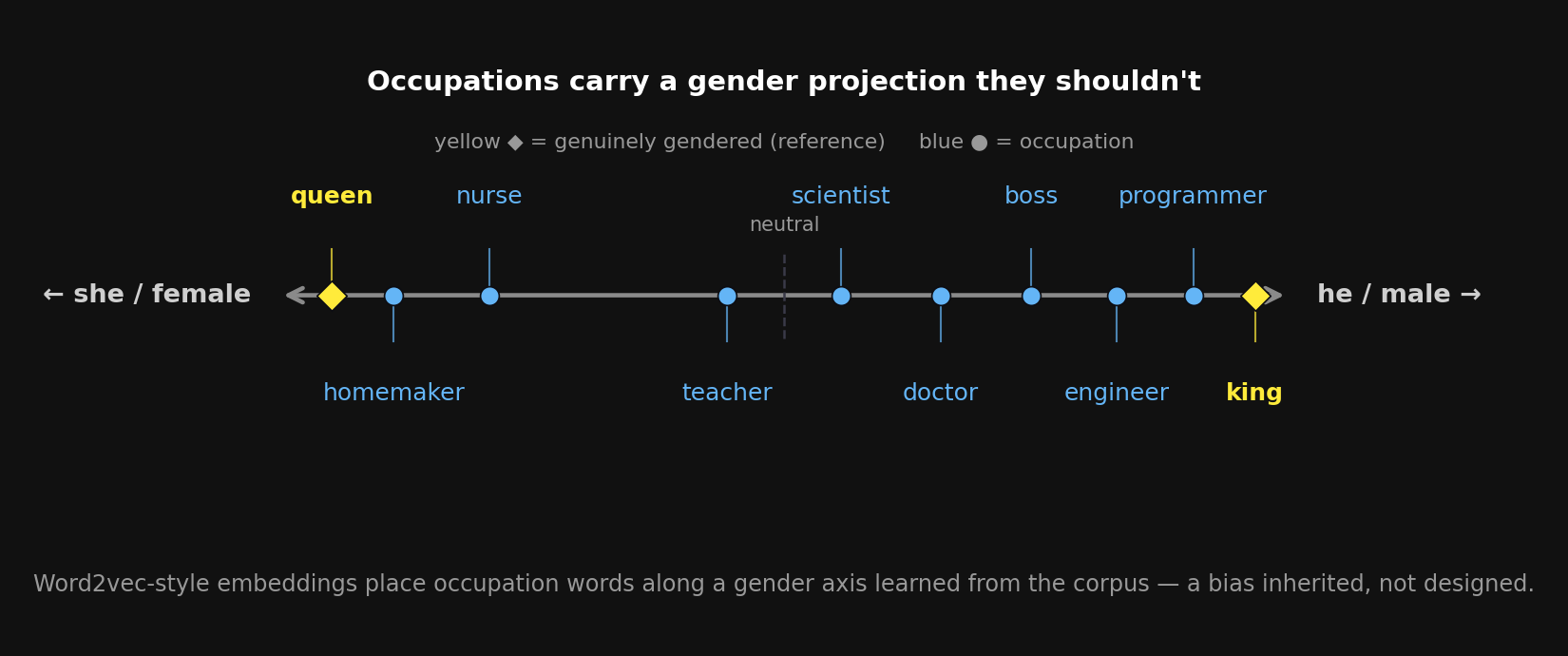
Week 11’s word vectors put occupation words on a gender axis nobody designed (Caliskan et al., 2017) — bias inherited from the corpus, in the geometry doing the useful work.
第11週の単語ベクトルが、誰も設計していない性別軸に職業語を並べる(Caliskan et al., 2017) — バイアスはコーパスから受け継がれ、有用な働きをする幾何に潜む。
Fairness is a conditional-probability statement公平性は条件付き確率の主張
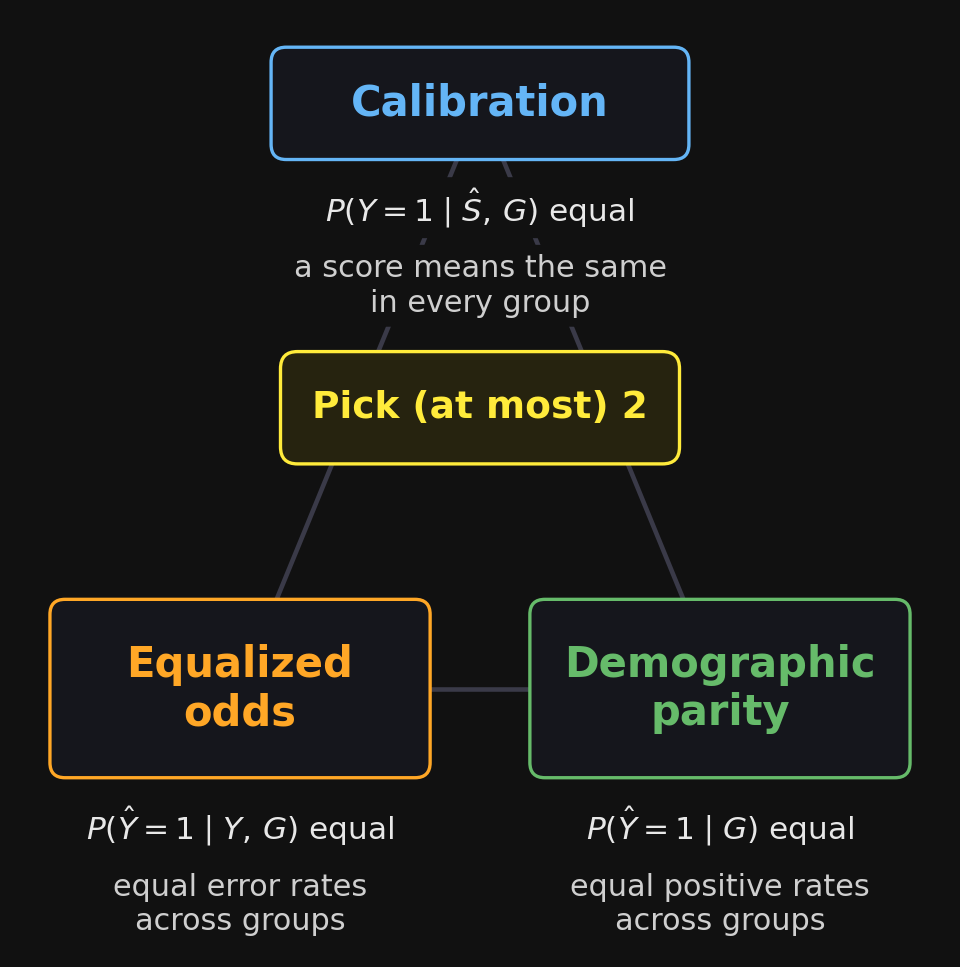
Demographic parity:\(P(\hat{Y}{=}1 \mid G)\) equal across groups
Equalized odds:\(P(\hat{Y}{=}1 \mid Y, G)\) equal — matched error rates
Calibration:\(P(Y{=}1 \mid \hat{S}, G)\) equal — a score means the same thing
人口統計的平等:\(P(\hat{Y}{=}1 \mid G)\) が集団間で等しい
均等化オッズ:\(P(\hat{Y}{=}1 \mid Y, G)\) が等しい — 誤り率が一致
較正:\(P(Y{=}1 \mid \hat{S}, G)\) が等しい — スコアの意味が同一
Each is a conditional-probability equality — the objects from Part I.
Fairness isn’t vague: you must choose which.
Next: they can’t all hold.
それぞれが条件付き確率の等式 — Part Iの対象。
公平性は曖昧ではない:どれかを選ぶ。
次:全部は満たせない。
You can’t have them all全部は満たせない
When base rates differ, no classifier satisfies all three (Kleinberg et al. 2016; Chouldechova 2017).基準率が異なるとき、三つすべてを満たす分類器は存在しない(Kleinberg et al. 2016; Chouldechova 2017)。
The COMPAS debate: ProPublica and the vendor were both right — they invoked different criteria.
Fairness is a modeling choice, stated in this course’s language: the math gives you the menu and the tradeoffs, not the answer.
A hiring model is equally accurate for every group. Is it fair?
ある採用モデルはどの集団に対しても同じ精度だ。これは公平?
A. Yes — that’s what fairness means
B. Not necessarily — it can hide unequal errors
C. Only if base rates are equal across groups
A. はい — それこそ公平の意味
B. 必ずしも — 不均等な誤りを隠しうる
C. 集団の基準率が等しい場合のみ
Reveal答え
B — equal accuracy can hide very unequal errors.B — 等しい精度は非常に不均等な誤りを隠しうる。
One shared accuracy number can hide who gets the false denials and who gets the false approvals.
Accuracy is not a fairness criterion — name the conditional probability you care about.
一つの精度の数値は、誤った却下と誤った承認が誰に向かうかを隠しうる。
精度は公平性の基準ではない — 気にかける条件付き確率を名指しする。
Why not C? Base rates are the wrong suspectなぜCではない?— 基準率は真犯人ではない
Equal base rates: still unfair
Both groups: base rate 50%, accuracy 80%.
A: 90% / 70% right on positives / negatives — B the reverse.
A’s innocents flagged 3× as often.
基準率が等しくても不公平
両集団とも:基準率50%、精度80%。
A:陽性/陰性で90% / 70%正解 — Bは逆。
Aの無実の人は3倍誤検知。
Unequal base rates: still fair
Both groups: 80% / 80% right on positives / negatives.
So accuracy = 80% at any base rate.
Base rates 30% vs 60%: equalized odds ✓.
基準率が違っても公平
両集団とも:陽性/陰性で80% / 80%正解。
ゆえに精度はどの基準率でも80%。
基準率30%対60%でも:均等化オッズ ✓。
Unfairness hides in the error mix — not in the base rates.不公平は誤りの配合に隠れる — 基準率にではない。
Adversarial examples: brittle geometry敵対的事例:脆い幾何
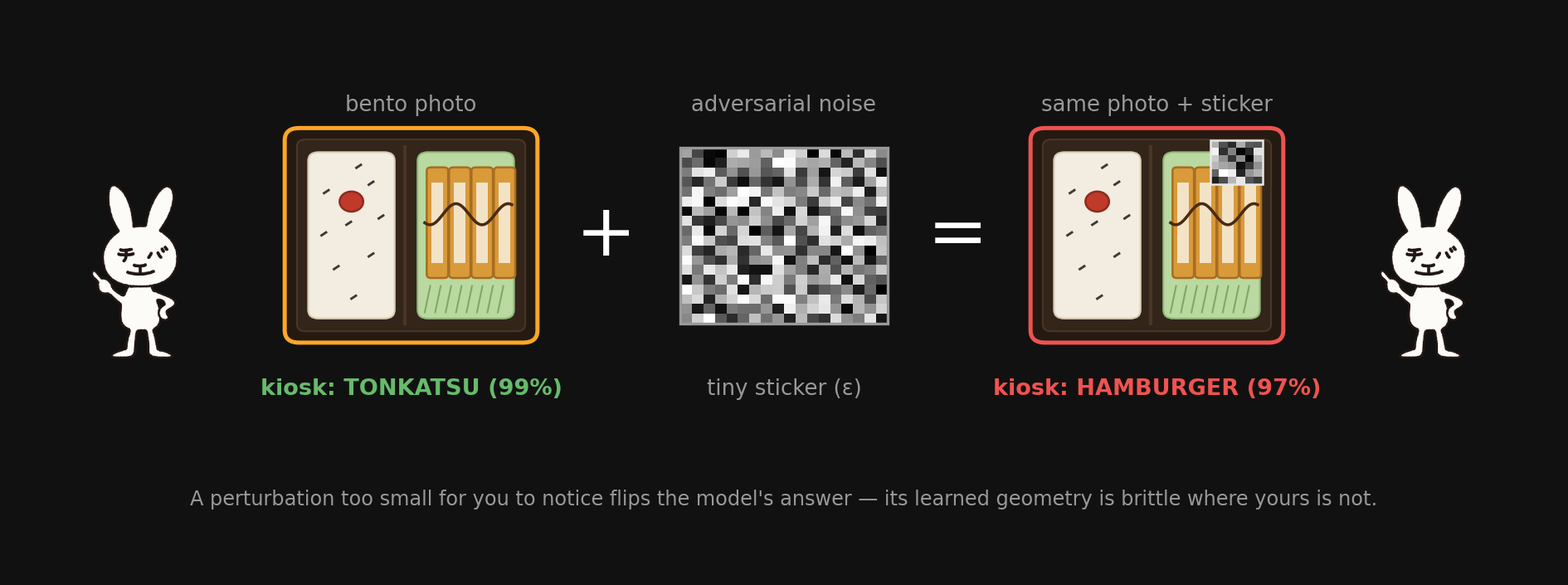
An invisible nudge flips the kiosk: tonkatsu → hamburger.
The attack: the loss gradient w.r.t. the input — jax.grad at \(\mathbf{x}\).
見えないほどの摂動でキオスクが反転:トンカツ → ハンバーグ。
攻撃は入力に関する損失の勾配 — jax.grad を \(\mathbf{x}\) に。
Alignment: teaching values is inferenceアラインメント:価値を教えるのは推論
Pretraining predicts text; helpful and safe is a second step — an inference problem you already know.
RLHF (Week 9): fit a reward from human preferences (Bradley–Terry, \(P(A \succ B) = \sigma(r_A - r_B)\)), then optimize the policy.
The reward is learned and imperfect, so the optimizer hacks it — Week 8’s reward-shaping trap.
That’s Goodhart’s law: when a measure becomes a target, it stops being a good measure.
事前学習はテキスト予測;有用で安全は第2段階 — すでに知っている推論問題。
RLHF(第9週):人間の選好から報酬を当てはめ(Bradley–Terry, \(P(A \succ B) = \sigma(r_A - r_B)\))、方策を最適化。
報酬は学習された不完全なものなので、最適化器はそれをハックする — 第8週の報酬整形の罠。
それがグッドハートの法則:指標が目標になると、良い指標でなくなる。
Value inference is inverse planning (Part VI) with the stakes maxed out.価値の推論は、賭け金を最大にした逆計画(Part VI)。
The full treatment is in Part IX詳細はPart IXに
The trailer ends here — Part IX carries the full treatment:
Adversarial examples — build the fast gradient sign method (FGSM)
Fairness, formally — the impossibility result as runnable code
Bias in data — the Word-Embedding Association Test (WEAT); the prior as power and liability
Alignment & safety — fit a reward, watch it get hacked
予告編はここまで — Part IXが本格的に扱う:
敵対的事例 — 高速勾配符号法(FGSM)を自分で作る
公平性の形式化 — 不可能性定理を実行可能なコードで
データのバイアス — 単語埋め込み連想テスト(WEAT);力であり負債でもある事前分布
アラインメントと安全性 — 報酬を当てはめ、ハックされるのを見る
Paper presentation論文発表
Final-project presentations最終プロジェクト発表
Three presentations · ~10 minutes each + brief Q&A · Background · Question · Method · Preliminary results
3件の発表 · 各約10分 + 短い質疑 · 背景 · 問い · 手法 · 予備的結果
Project 1プロジェクト 1
Project 2プロジェクト 2
Project 3プロジェクト 3
Semester retrospective学期の総括
Pulse — before we map itパルス — 地図にする前に
A quick go-around — one answer each, not a discussion:
Which paper this semester surprised you most?
Which one will you re-read in a year?
手短に一巡 — 各自ひとつ、議論ではなく:
今学期、最も驚いた論文は?
一年後に読み返すのはどれ?
The map of the semester学期の地図
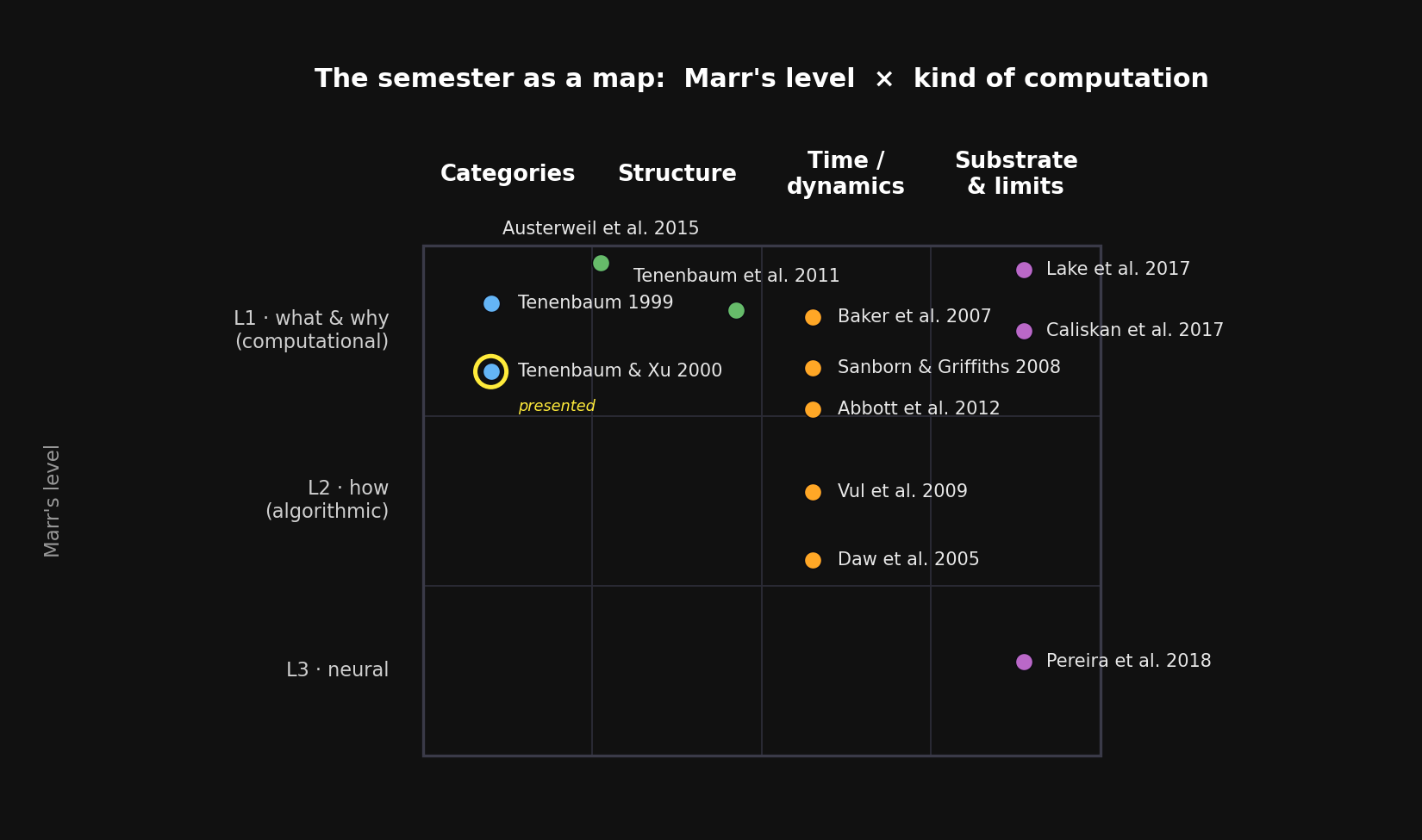
Every paper you saw, on two axes: Marr’s level (what · how · neural) and the kind of computation (categories · structure · time · substrate). One science, many corners.
The left column isn’t history — still cog-sci’s working tools today.左の列は歴史ではない — 今も認知科学の現役の道具。
The opportunityこの機会
AI has mostly stopped looking at Bayesian models of minds — an opening:
AIは心のベイズモデルをほぼ見なくなった — それは好機:
Cognition → AI
AI lacks priors, structure, rational analysis.
Use them to understand and improve today’s systems.
認知 → AI
AIには事前分布・構造・合理分析が足りない。
それで今日のシステムを理解し、改善する。
AI → cognition
Classic Bayesian models need small, idealized data.
With AI inside, they finally meet real-world data.
AI → 認知
古典的ベイズモデルは小さく理想化されたデータを要する。
AIを組み込めば、ついに実世界データに届く。
Few people can speak both languages. As of this semester, you can.両方の言語を話せる人は少ない。今学期を終えたあなたは話せる。
What you leave with持ち帰るもの
Not a fixed set of answers — a toolkit. A generative model, a prior, an inference, the inversion of planning. You can now open a 2026 paper and see what problem it is trying to solve.
Chibany just wanted to know what was for lunch. That question — what’s hidden, given what I see? — turned out to be the whole science.